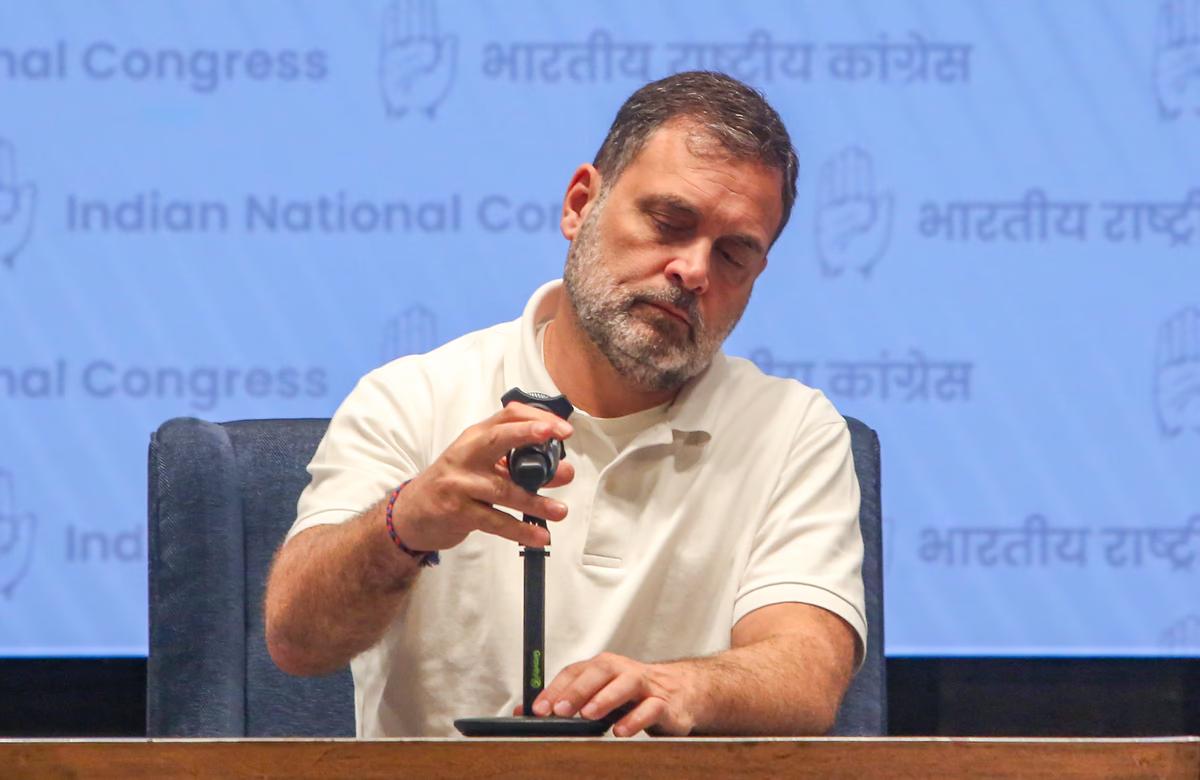
Calling Rahul Gandhi a mythmaker is no longer a political irony. Nowadays, politics is replete with shilly-shally portrayals of half-truths and unscrupulous narratives. Rahul Gandhi’s prevarication against the government abroad has increasingly come to be perceived as the result of his gradual shrinking as the captain of a sinking ship. Of course, with more than a decade of political maneuvering, he has recently unsettled the quietude in the saffron camp. He has begun to deeply disturb even the finest spokespersons on the BJP side. The party sees his allegations as ineluctable and in need of firm response. Before foreign audiences, Rahul Gandhi scrupulously maintains a uniform style of oratory that frequently portrays India in its most vulnerable light. His recent remarks at the Hertie School in Berlin echoed the same familiar paraphrasing about India and its present administration.
But the common man is perplexed from top to bottom, for he fails to discover why the Leader of the Opposition in the Lok Sabha evades decent discourse while the crass cacophony in Parliament not only disrupts the proceedings of the House but frequently irritates the electorate. Inside Parliament and through the allegations he perniciously declares outside India, he awards himself the joy of being the lone crusader of democracy, destined to save it from the clutches of an authoritarian regime. His peculiar assertion that the Bharatiya Janata Party is deploying its full force to completely eliminate the Constitution has found repetition in both context and language. His portrayal of the Modi government as a disruptive game-changer which operates through unethical means remains a constant but counterfactual argument. However, India’s electorate does not appear to have embraced this argument.
Rahul Gandhi contends that the BJP’s electoral successes are the result of the party’s unscrupulous attempts to capture democratic institutions such as the Election Commission. Undoubtedly, this argument is thrust directly at the electorate, with Gandhi summarizing that it was not merit but the BJP’s alleged coercive intrusion into institutional frameworks that enabled its gains thus far. This fissiparous narrative about the country’s electoral process is directly an accusation against those who voted the BJP to power. Similarly, his ideological fallacies regarding the electoral process further undermine his party’s winning performance in the states where it has come to power. Where does Rahul Gandhi take such an unpardonably questionable stand? His questioning the electoral mandate of the BJP has often involved finger-pointing at the Hindu majority, which the world is well aware constitutes the largest segment supporting the right-wing political discourse in India.
Before dismissing these accusations as stemming solely from his party’s prolonged helplessness and political distress at being pushed out of a winnable electoral process, one must also consider his evident personal disconsolation at being removed from the corridors of power. Further addressing the audience in a reflective and philosophical tone, Gandhi sought to depict the saffron dispensation as driven by divisive and illiberal intent. He concluded by alleging that the Modi government is actively working to erode equality between states and among languages and religions.
If enmity in politics is ideological, such ideological disapproval can strengthen the quality of democratic dialogue. However, the semantics of political positioning become more sinister when ideological displeasure gives way to acrimonious rhetoric. Rahul Gandhi sounded the same bugle during an interaction at EIA University in Columbia by saying that “The single largest risk is the attack on democracy that is taking place in India, because India has multiple religions, multiple traditions, and multiple languages.” He argued that this multiplicity requires a platform for dialogue, and that democracy is the principal platform that allows such diversity to flourish.
Pluralism, for all practical reasons, is the best way to define India and the only way in which it can afford to survive as a nation. It possesses unquestionable depth within India’s social framework and stands as the core principle that has enabled the country to sustain its democracy. Pluralism in India has preserved a cultural continuum, allowing the polity to absorb political shifts without dismantling the pluralistic foundations of society.
Political interventions, however, often disproportionately disrupt this ideologically diverse social structure through dystopian measures. Leaders such as Rahul Gandhi appear largely oblivious to the strength and veracity of this cultural backing, which continues to keep the country culturally stable, civilizationally rooted, and socially connected.
Apparently, there is a serious disconnect between the Leader of the Opposition and a large chunk of the Indian electorate. This is because Gandhi has failed to read the collective and pluralistic cultural background of the Indian state, which is its actual treasure. The government he repeatedly calls “majoritarian” has, in fact, understood that politics in India can no longer survive while treating the cultural leanings of the majority of the electorate with contempt.
India is a nation built on the collective conscience of a population that, for millennia, struggled to preserve its civilizational identity from external acrimony and from structural misdemeanors by ruling establishments since independence. To understand this, Rahul Gandhi needs to step aside and view India’s cultural landscape with complete spiritual involvement. The outcome of such understanding may eventually be political, but his engagement must first be deeply cultural. Every country carries a profound history of civilizational struggles, which serve as reminders throughout its formative journey toward a strong democratic evolution.
India, too, has traveled through a rich spiritual ancestry that continues to keep its diverse cultural expressions united. Yet this very diversity of expression is what Rahul Gandhi vociferously cites as a reason for dissent, portraying India as a country that, according to him, is forcefully held together by a political mechanism. When he claims that India is merely a clump of states bound together by the power of a democratic system, he blatantly rejects its civilizational unity and implicitly justifies the possibility of its disintegration. This is the dangerous mindset that the BJP and other nationalist institutions find alarming.
By calling for an outrageous agitation by Gen Z, similar to movements elsewhere that have toppled governments, Rahul Gandhi is exposing his true intent. He appears to believe that, with its steady economic growth and rising international reputation, India is unlikely to become a fragile or breakable entity in the near future. Consequently, his political calculus seems to guide him toward portraying and potentially manipulating the country as a state of cultural chaos, if not domestically then at least in international forums.