
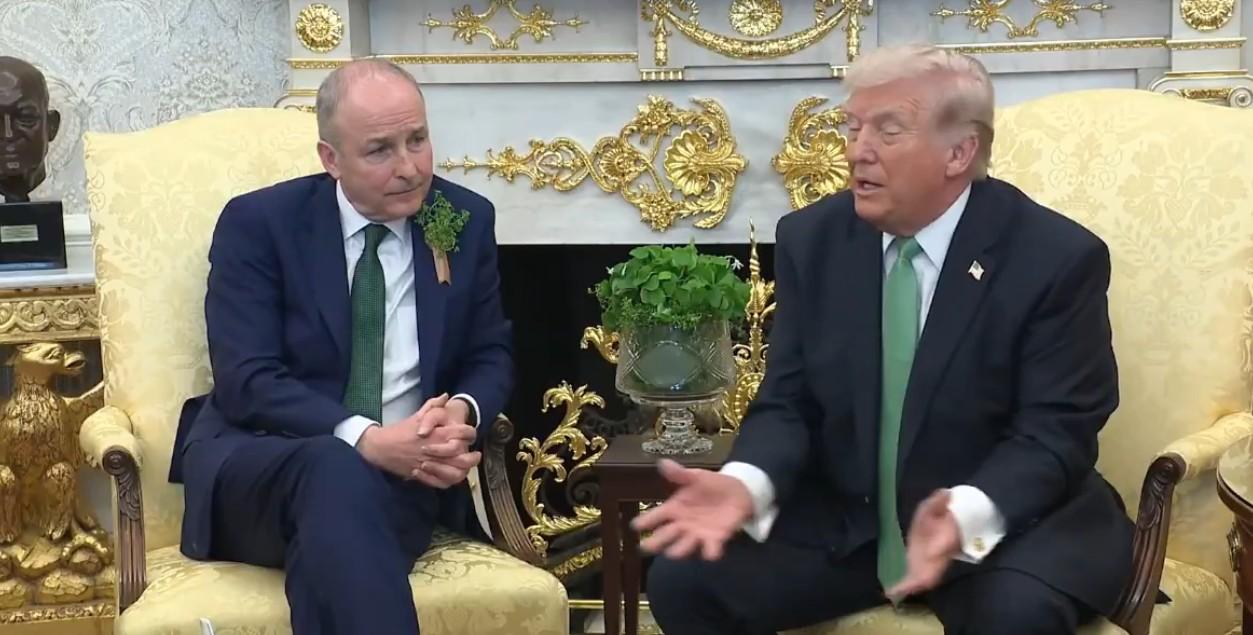
Washington, March 17 (IANS) US President Donald Trump is “angry” over European allies’ refusal to support operations in the Strait of Hormuz, Senator Lindsey Graham said Tuesday, as Trump criticised NATO for failing to back Washington’s Iran strikes during talks with Irish Prime Minister Taoiseach Micheál Martin.
Meeting Prime Minister Micheal Martin of Ireland at the Oval Office, Trump said the US acted decisively against Iran and did not require allied support, even as he questioned NATO’s response.
“Well, we don't need too much help, and we don't need any help actually,” Trump said. “This is a great test, because we don’t need them, but they should have been there.”
He said NATO allies backed the action in principle but failed to contribute. “I was surprised to see that NATO, while they agreed that it was a very important thing to do… when they say it was a threat, but we’re not gonna help, I think they’re very foolish.”
Trump argued the US operation had effectively dismantled Iran’s military capability. “We’ve wiped out their navy, wiped out their military of every aspect. Their Air Force is now decimated,” he said, adding, “they have no air force, no navy, they have no radar.”
He reiterated that the objective was to prevent Tehran from acquiring nuclear weapons. “They would have had a nuclear weapon within one month,” Trump said, adding, “Iran was a tremendous threat.”
At the same time, he praised the support from regional partners. “We’ve had great support from the Middle East,” he said, naming Qatar, the UAE, Saudi Arabia, and Bahrain, and adding, “Israel’s been very, very strong… It’s been a very strong collaboration.”
Graham said he had spoken to Trump about the lack of European support in securing the Strait of Hormuz. “I have never heard him so angry in my life,” he said, adding he shared that anger over “our European allies’ unwillingness to provide assets to keep the Strait of Hormuz functioning.”
“The arrogance of our allies to suggest that Iran with a nuclear weapon is of little concern and that military action to stop the ayatollah from acquiring a nuclear bomb is our problem, not theirs, is beyond offensive. The European approach to containing the ayatollah’s nuclear ambitions has proven to be a miserable failure,” he said.
Graham warned of broader consequences. “The repercussions of providing little assistance to keep the Strait of Hormuz functioning are going to be wide and deep for Europe and America,” he said.
He also criticised Europe’s approach to Iran. “The European approach to containing the ayatollah’s nuclear ambitions has proven to be a miserable failure,” he said, adding it made him “second-guess the value of these alliances.”
Vice President JD Vance highlighted ongoing threats in the region. “There have been a lot of militia attacks against our base… and we’ve got to eliminate them when we find them,” he said, adding that such groups “can’t” be allowed to obtain nuclear weapons.
Martin, seeking to strike a conciliatory tone, underscored the importance of US-Europe ties. “The transatlantic relationship between Europe and the US is very, very important,” he said, adding that despite tensions, “we can get a landing zone again.”
He agreed that Iran posed a serious risk but stressed the need for diplomacy. “You cannot have a rogue state with a nuclear weapon,” Martin said, while adding, “What we want is a peaceful resolution of conflict.”
--IANS
lkj/dan