
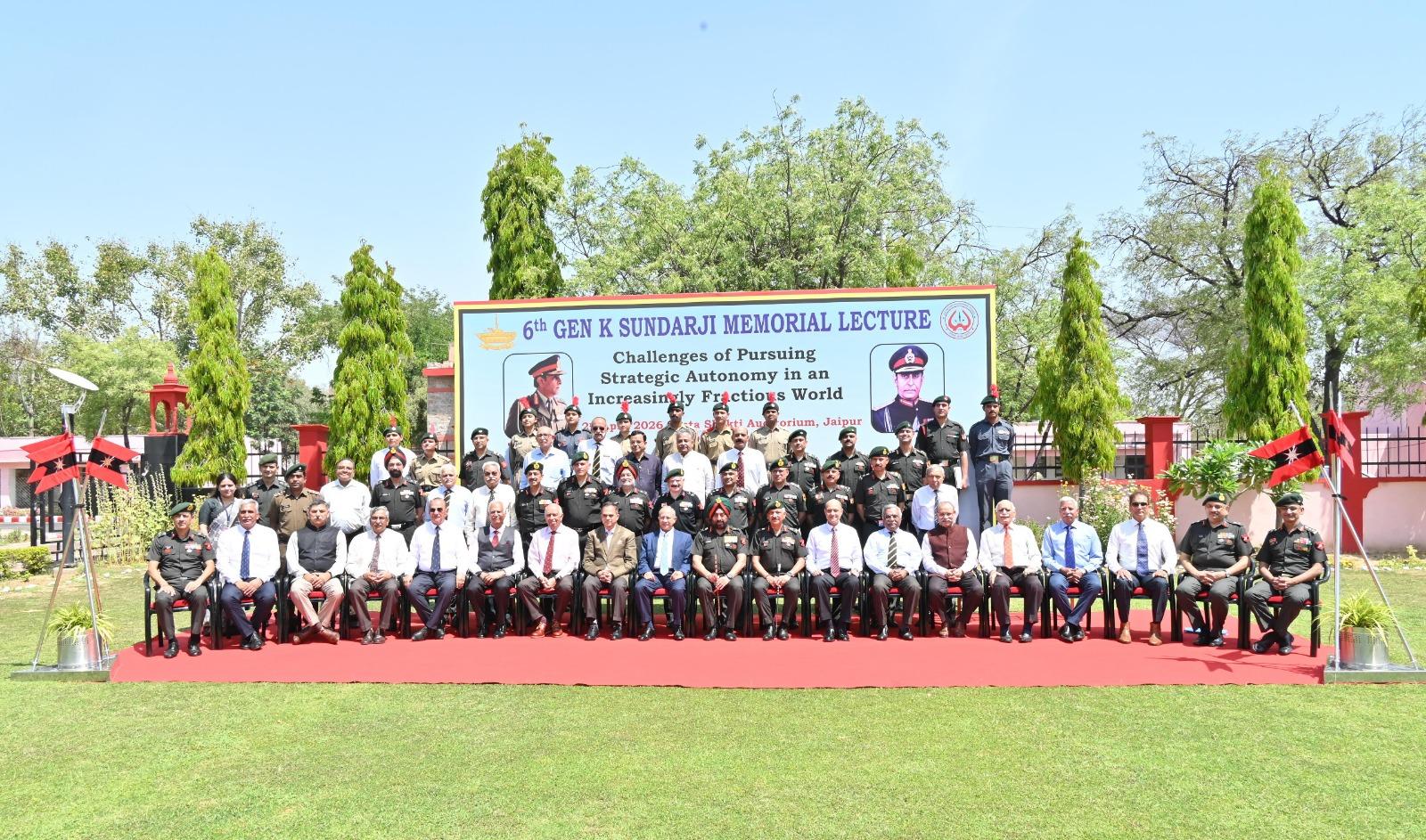
Jaipur, April 2 (IANS) The 6th Edition of the General K. Sundarji Memorial Lecture was conducted on Thursday at the Sapta Shakti Auditorium, Jaipur. Hosted by the Mechanised Infantry Centre & School (MIC&S) in collaboration with the Centre for Land Warfare Studies (CLAWS), the seminar deliberated on the theme, “Challenges of Pursuing Strategic Autonomy in an Increasingly Fractious World.”
Lieutenant General Manjinder Singh, Army Commander, Sapta Shakti Command, delivered the keynote address, setting the stage for a high-level intellectual exchange.
He highlighted the imperative of strategic autonomy in an era marked by geopolitical volatility and complex security challenges.
He emphasised that, against the backdrop of a rapidly evolving global order defined by intensifying great power competition, geo-economic fragmentation, technological contestation, and regional conflicts, strategic autonomy is no longer merely a diplomatic aspiration but a practical necessity for safeguarding a nation’s sovereignty, economy, security, and long-term interests.
Paying tribute to General Krishnaswamy Sundarji, a transformational military leader and visionary strategist, the event highlighted his enduring legacy of doctrinal innovation, technological modernisation, and institutional reform, which continues to guide India’s strategic thinking.
The seminar featured eminent speakers, including Ambassador Pankaj Saran, former Deputy National Security Adviser, and Vice Admiral Sanjay Jasjit Singh, Director General of the United Service Institution of India.
Drawing upon their extensive experience, the speakers provided valuable insights into how India can safeguard its sovereign decision-making in a volatile global environment.
The discourse presented a balanced perspective, integrating both diplomatic and military viewpoints.
Key discussions focused on recalibrating India’s foreign policy in a multipolar world; the impact of emerging technologies and geo-economic competition on national security; strengthening defence preparedness, jointness, and indigenisation; maritime security in the Indo-Pacific; and balancing economic integration with national resilience.
The deliberations also examined emerging geopolitical developments, including the implications of recent conflicts for India’s strategic calculus.
The seminar emphasised that contemporary strategic autonomy demands resilience across critical domains, including technology, energy, cyber, space, and secure supply chains, along with credible deterrence and the ability to build partnerships without strategic dependency.
Over the decades, MIC&S has evolved into one of the Indian Army’s most modern training institutions and serves as the fountainhead of expertise in Infantry Combat Vehicles (ICVs) and mechanised warfare tactics.
The institution has trained personnel across all arms equipped with ICVs, including 50 battalions of the Regiment, and conducts advanced courses for Indian Army personnel, the Indian Coast Guard, and friendly foreign countries.
A state-of-the-art Urban Warfare Training Node is also being established at Ahilyanagar.
Closing the proceedings, Lieutenant General P.S. Shekhawat, Chief of Staff, Sapta Shakti Command and Colonel of the Mechanised Infantry Regiment, expressed gratitude to the speakers for their thought-provoking insights and underscored the importance of intellectual rigour in navigating contemporary geopolitical challenges.
The event successfully brought together policymakers, military professionals, and strategic thinkers, generating forward-looking insights to strengthen India’s strategic posture while honouring the legacy of General Sundarji and reaffirming the commitment to a strong, self-reliant, and future-ready India.
--IANS
arc/dan