
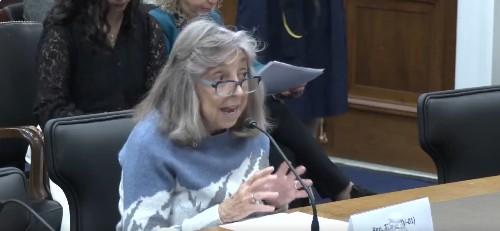
Washington, March 6 (IANS) The rising population of wild horses on US public lands and the high cost of managing them came under scrutiny in the Congress as lawmakers examined proposals to expand fertility control and reduce reliance on costly holding facilities.
The discussion came during a hearing of the House Appropriations Subcommittee on Interior, Environment, and Related Agencies on Friday as lawmakers began gathering priorities for the fiscal year 2027 spending bill.
"The current approach to equine management by the Bureau of Land Management is just simply not sustainable for taxpayers, for animal welfare, or for the long-term health of our public lands," Representative Dina Titus of Nevada said.
She noted that between fiscal years 2022 and 2024, the Bureau of Land Management removed more than 41,000 horses and burros from the range.
"Today, over 64,000 of these animals are warehoused in short-term, or in some long-term, holding facilities and that number may soon exceed those that are left on the range," she said.
Titus added that relying primarily on roundups and long-term holding facilities was both costly and ineffective.
"The agency's own data shows that the removal and lifetime holding of horses costs nearly $48,000 per horse," she said.
"In 2024 alone, nearly two-thirds of the entire programme was spent on roundups and just warehousing these horses."
She urged lawmakers to expand the use of fertility control to stabilise wild horse population.
"For fiscal year 2027, I request respectfully that at least 10 per cent of the Wild Horse and Burro Program would be dedicated to using it for humane, irreversible, or reversible fertility control," Titus said.
"These animals are iconic symbols of the American West, they're beloved around the world, and they deserve humane stewardship, not just a pipeline to holding kill pens," she added.
House Appropriations Subcommittee on Interior, Environment and Related Agencies Chairman Mike Simpson, acknowledged the scale of the challenge and the programme's growing costs.
"We spent $144 million last year on horses and burros," he said, adding: "I tell that to the public and they're stunned how much it costs."
He said that US Congress has struggled for years to find a workable solution to control the population.
"I don't have the answer to it, but I'm open to any ideas that somebody might have to control it because they are -- it's not healthy for them and it's not healthy for our public lands," Simpson added.
Titus also raised concerns about proposals to reduce national monuments or sell public lands, warning that such moves could undermine conservation efforts and cultural heritage across the western US.
"Public lands certainly across the West are part of the fabric of who we are," she said, urging lawmakers to include protections in the Appropriations Bill.
Wild horses and burros have been protected under US federal law for decades, but their growing numbers have created tensions between conservation groups, ranchers and land managers over how best to manage public lands.
--IANS
lkj/khz