
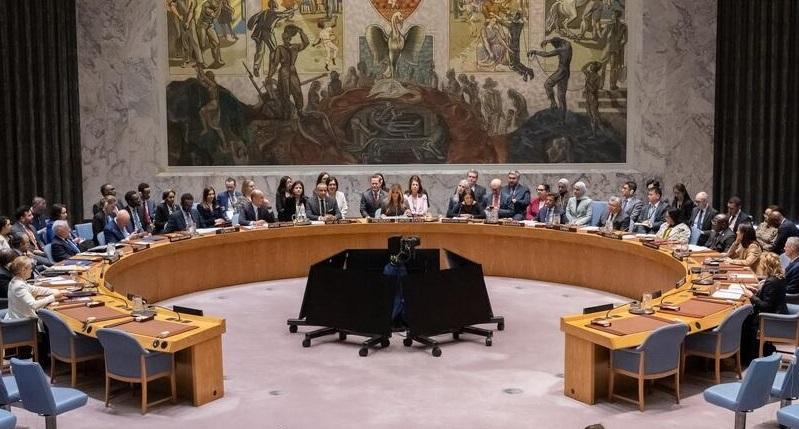
United Nations, March 5 (IANS) In a stark portrayal of the Security Council’s polarisation that paralyses its work, a dispute between the US and a combination of Russia and China over charting Iran in the month’s agenda has stalled the adoption of its programme of work while Washington presides over it.
After a flamboyant start on Monday when US First Lady Melania Trump presided over the first open session of the month under the US presidency, the Council went dormant the next two days and is to resume on Thursday.
Without a programme of work, which has to be unanimous, the US, in a sleight of diplomacy, published what it called a “Plan of Work” with meetings pencilled in for 11 days of the 21 working days of the month and ten left blank.
Asked about the imbroglio, Secretary-General Antonio Guterres’ Spokesperson Stephane Dujarric said, “Frankly, we’ve been concerned about the lack of unity in the Security Council for some while now, in dealing with a number of issues”.
“I think the Security Council has a primary responsibility in the maintenance of peace and security, and we encourage members to find common ground to that end,” he said.
In an unusual action, Russia went public with the dispute, posting a note on its mission’s website on why Moscow and Beijing prevented the adoption of the programme of work.
At the heart of the dispute is the US calling for a briefing on the work of the sanctions committee for Iran on Tuesday, exercising its authority because it has the alphabetically rotating presidency for March.
The committee is known as the 1737 Committee after the number of the Council resolution on the 2015 Iran nuclear deal, known as the Joint Comprehensive Plan of Action (JCPOA).
Under the deal, the sanctions were loosened, but the resolution provided for a “snapback” -- the reimposition of sanctions if Iran did not comply with the JCPOA restrictions on its nuclear programme.
Britain, France and Germany, which were parties to the JCPOA, declared that Iran had broken the deal by enriching uranium beyond the levels imposed and invoked the snapback.
Russia said that the three countries “had no right to invoke this mechanism” and “there is no consensus within the Security Council on the legality of the actions taken by the UK, France, and Germany”.
Since the US turned down its request not to put the 1737 Committee’s work on the agenda, “we had no other choice but to object to the adoption of the UNSC programme of work for March”.
Russia had also blocked the adoption of the programme of work in 2023 during the US presidency.
Traditionally, the Council presidents hold two signature events on issues important to them with high-level participation.
The US held one on Monday with Melania Trump on children, education and technology, and has scheduled another on “Energy, Critical Minerals, and Security” on Thursday.
The situations in Palestine, Syria, Myanmar and Afghanistan also figure in the US plan of work.
--IANS
al/dpb