
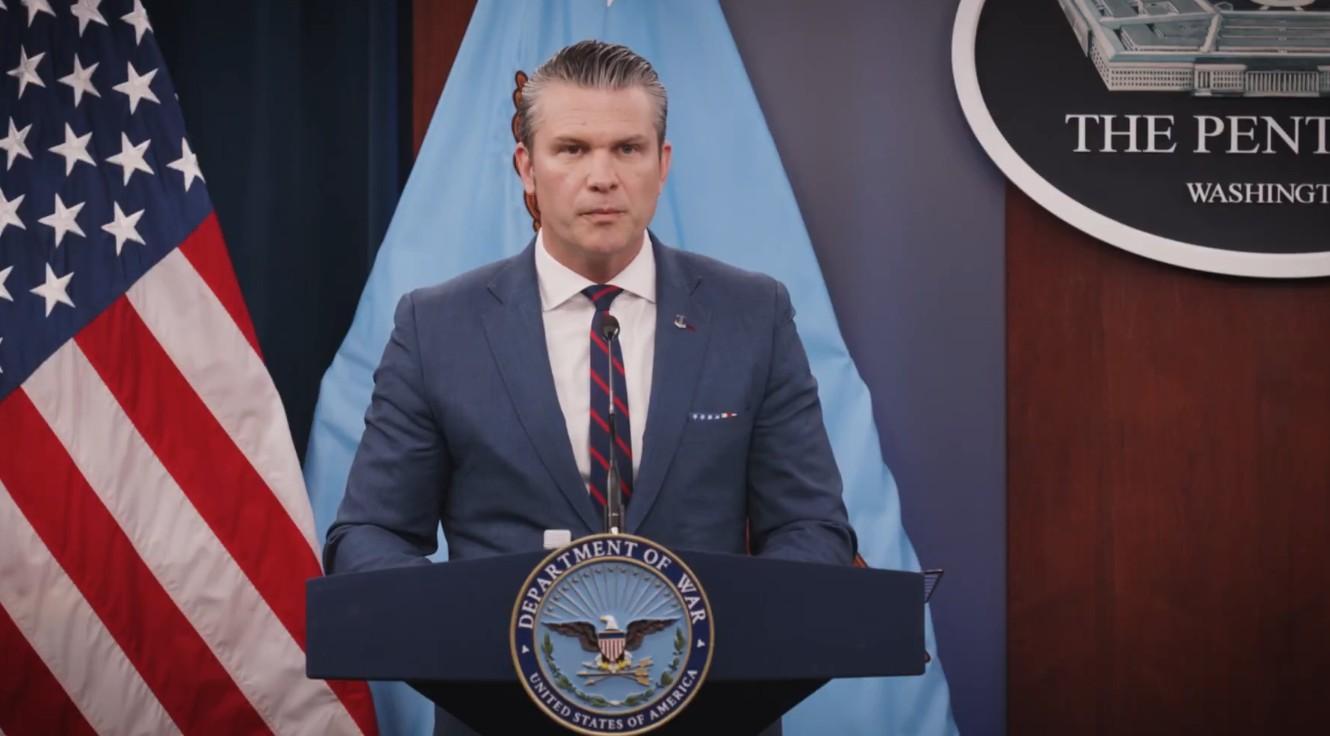
Washington, March 19 (IANS) The United States has struck more than 7,000 targets inside Iran and is intensifying operations, with Defence Secretary Pete Hegseth asserting that Tehran’s military capabilities have been significantly degraded even as the conflict enters a more aggressive phase.
“We're winning decisively and on our terms,” Hegseth told reporters at a Pentagon news conference as he pushed back against concerns of a prolonged war.
He stressed that the campaign remains “laser focused” and “decisive,” aimed at dismantling Iran’s missile systems, defence industry, and naval power while preventing it from acquiring nuclear weapons.
Hegseth said ballistic missile attacks on US forces are “down 90 per cent since the start of the conflict,” adding that similar reductions were seen in drone attacks. “Now the Iranians will still shoot. We know that, but they would shoot a lot more if they could. But they can't,” he said.
The Pentagon described a broad and sustained military effort across Iranian territory. Joint Chiefs Chairman General Dan Caine said US forces are “on plan” and continuing to strike deeper targets, including underground facilities.
“Yesterday the U.S. military dropped 5,000-pound penetrator weapons into underground storage facilities,” Caine said, adding that operations are expanding “further to the east now and penetrating deeper into Iranian airspace.”
The US has also targeted Iran’s naval capabilities. Hegseth said more than 120 vessels have been damaged or sunk and claimed Iran’s submarine fleet has been effectively neutralised. “Their surface fleet is no longer a factor,” he said.
Caine detailed the operational tempo, saying US forces are “unrelenting in our pursuit of Iranian missile capabilities” and continue to “hunt and kill mine storage facilities and naval ammunition depots.”
The Pentagon also highlighted expanded use of airpower. A-10 aircraft and AH-64 Apache helicopters are now operating across the southern flank, including in the Strait of Hormuz, targeting fast attack craft and drone positions. Bomber aircraft, including B-1s, B-2s, and B-52s, are conducting long-range strike missions supported by extensive aerial refuelling.
Despite the intensity of operations, US officials declined to offer a timeline for ending the campaign. “We're very much on plan,” Hegseth said, adding that the decision on when to conclude operations would rest with President Donald Trump.
The Defence Secretary framed the conflict as a direct response to Iran’s long-standing actions. “They have been at war with us, whether we acknowledge it or not, for 47 years,” he said, citing attacks on US personnel and support for militant groups across multiple theatres.
Iran retains some offensive capability, the general said. “They came into this fight with a lot of weapons,” Caine said, noting continued missile launches and the need for layered defence systems across the region.
Hegseth also confirmed strong support from regional allies. “The Gulf states have stepped up incredibly,” he said, naming countries including the UAE, Qatar, Bahrain, Kuwait, and Saudi Arabia as key partners alongside Israel.
The Pentagon said it is also countering Iran’s information efforts amid internet blackouts inside the country. Hegseth accused the Iranian regime of spreading “fake AI-generated images” to shape perceptions of the conflict.
--IANS
lkj/dan