
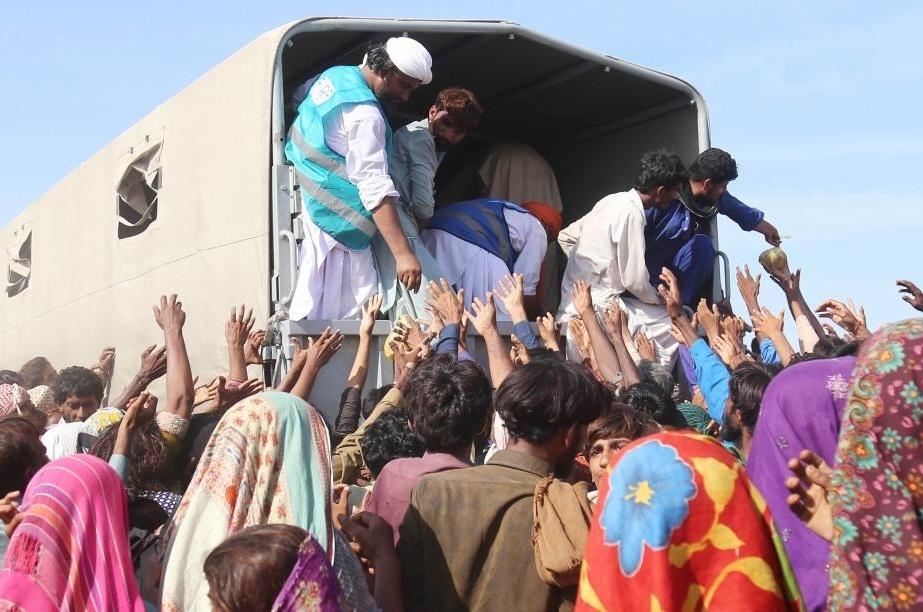
London, March 7 (IANS) Pakistan’s growing poverty has disrupted socio-economic stability, fuelling child labour and widening inequalities, while financial hardships restrict access to education, especially for women.
Critics and experts argue that despite financial and developmental assistance from global institutions, “ineffective and inefficient” government policies, political instability, and widening inequality has driven the worsening poverty situation across Pakistan.
Citing Acute Food Insecurity (AFI) analysis by the Integrated Food Security Phase Classification (IPC) - a standardised analytical framework governed by a consortium of international institutions - a report in UK-based 'Asian Lite' newspaper highlighted that rising inflation, coupled with sluggish economic growth, has resulted in new vulnerabilities in Pakistan.
“These include an increase in poverty levels, heightened reliance on debt to meet basic needs, and greater adoption of livelihood-based coping strategies. Economic instability has further reduced income opportunities, exacerbating vulnerabilities,” the report quoted IPC as saying.
According to Miftah Ismail, former Pakistani finance minister, hunger and poverty are spreading across the country with declining real incomes since 2021, leaving one-quarter of the population uncertain about whether they would have enough to eat.
Additionally, Pakistani author and columnist Mansoor Ahmad said that children are among the worst affected by poverty, as financial distress forces families to send their children to work, trapping them in a cycle of intergenerational poverty.
“The persistence of child labour in Pakistan is not primarily a legal failure; it is an economic failure. Poverty remains the strongest driver. When adult wages are insufficient to sustain households, children become economic assets,”Asian Lite quoted Mansoor as saying.
The report cited a recent World Bank report stating that nearly 45 per cent of the Pakistani population was living below the poverty line.
Large sections of the population in Pakistan were deprived of basic facilities, while a handful of elites enjoyed privileges with impunity, said educationist Saira Samo.
“Pakistan’s decay reflects decades of failed leadership. This is not the result of misfortune or circumstance; it is the cumulative effect of decades of political opportunism, weak governance and leadership that have consistently placed personal or partisan interests above the nation’s welfare,” the report quoted Samo as saying.
Rashid Amjad, a professor at the Lahore School of Economics, said that poverty in Pakistan was unlikely to decline due to the country’s failure to generate new jobs and stimulate economic growth.
“Unfortunately, this did not happen,” Asian Lite quoted him as saying, noting that Pakistan required at least 5-6 per cent economic growth to eradicate poverty.
“Indeed, it is highly unlikely, as past experiences in other developing countries and in Pakistan have shown, for an economy to witness increasing economic growth and falling poverty at the same time as it undergoes an IMF stabilisation and reform programme,” said Amjad.
--IANS
scor/as