
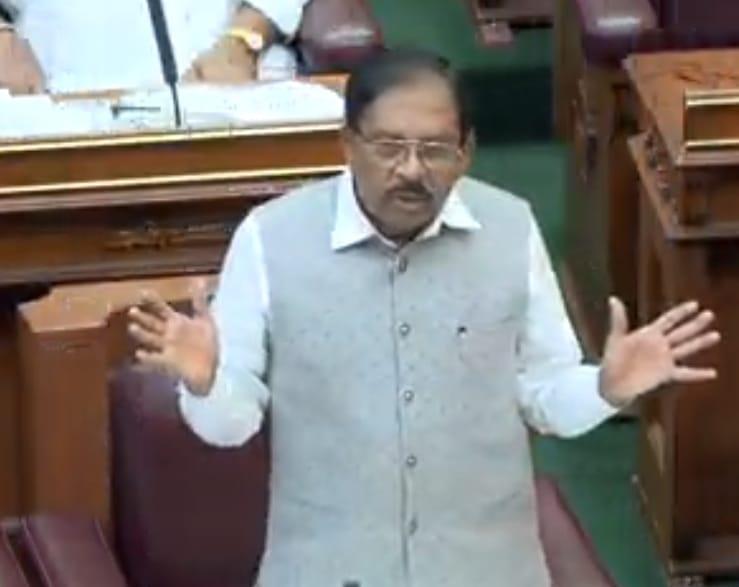
Belagavi (Karnataka), Dec 18 (IANS) The Congress-led government in Karnataka, on Thursday, has reduced the punishment for hate crimes prescribed in the controversial Karnataka Hate Speech and Hate Crimes (Prevention and Control) Bill, 2025, from 10 to seven years.
Karnataka Home Minister G. Parameshwara made the statement while explaining the Bill in the State Assembly after the House passed it.
He said that he believes the legislation will bring a significant change in society.
"I also believe that if people are aware of the existence of such a law, there will not be any problem in society," he underlined.
"Under the Bill, a person committing a hate crime will be punished with imprisonment of not less than one year, which may extend up to seven years, along with a fine of Rs 50,000. For a subsequent or repeated offence, imprisonment of not less than two years, extendable up to seven years, along with a fine of Rs 1 lakh, has been prescribed," Minister Parameshwara said.
"Considering various opinions, the state government has withdrawn the provision prescribing 10 years of imprisonment for repeated offences," the Home Minister clarified.
He added that offences under the Bill will be cognisable, non-bailable and triable by a Judicial Magistrate of the First Class.
"The Bill also covers the creation of hatred through books, pamphlets, papers, paintings, drawings and other representations. If the offence is committed by an organisation or institution, every person responsible for its conduct at the time of the offence will be deemed guilty. This provision applies to both registered and unregistered organisations," Minister Parameshwara added.
"The designated State authority has been empowered to block or remove hate content, including material circulated through electronic media and platforms such as YouTube," he said.
Senior BJP MLA V. Sunil Kumar asked whether old books preaching violence and hatred would be banned?
"Old publications or books would be banned. Provisions not covered under the Bharatiya Nagarik Suraksha Sanhita Act have been incorporated here," BJP leader Kumar said.
Minister Parameshwara said that old books would be banned otherwise the inciteful content would be made available in the one form or the other.
BJP MLA Sunil Kumar warned the Karnataka Home Minister about consequences of this provision and said that he would debate it later.
Explaining the rationale behind the Bill, Minister Parameshwara said that in recent times, across the country and in Karnataka, certain groups and individuals have been making statements that cause pain to society, and such instances are increasing.
"I will not go into details about who made such speeches or what was spoken. It would not be appropriate here. However, harsh words and statements have been used. What is their impact on society? In many cases, communities have clashed and society is moving in a direction where it may lose order. Do we have to tolerate this?" he asked.
Recalling his personal experiences, the Home Minister said he had faced social boycott and humiliation during his childhood.
"When I was going to school, neighbouring villagers did not allow us to enter their village. When we asked for water, they poured it from a height and we had to drink by joining our hands. This is my personal experience," he added.
Minister Parameshwara noted that India is progressing well and is recognised as one of the world's largest democracies and economies.
"When we go outside the country, we claim that we are a powerful nation. About 2,500 years ago, Lord Buddha was born in this land and, after attaining enlightenment, preached equality, saying that all humans are the same. Yet, inequality has not disappeared for thousands of years," he said.
He also referred to social reformer Basavanna, saying that even after Basavanna challenged casteism and propagated equality around 850 years ago, inequality continued to persist.
"In today's scenario, individuals make speeches targeting communities. If such speeches create hatred against another community or individual, is that acceptable in a modern society?" he asked.
He said that prejudice continues on the basis of religion, race, caste, community, sex, gender, sexual orientation, place of birth, residence, language and disability, and all these aspects have been included in the Bill.
Defining hate crime, Minister Parameshwara said it refers to the communication of hate speech by making, publishing, promoting, propagating, inciting or abetting such speech to cause disharmony or enmity against any individual or group, living or dead.
"I have newspaper clippings of hate speeches. Such speeches provoke people to the extent of committing violence or even murder. The words pit one community against another and claim that a particular group must be dealt with," he added.
The Home Minister said protecting women and children has become a major challenge, and that youths, who constitute nearly 60 per cent of the population, can be easily incited through hate speech.
"As Home Minister, we often receive reports that if a particular person delivers a speech in a district, it could lead to law and order problems. We ban their entry, but how many times can we do this? Unless there is a strong legal provision, such actions cannot be curbed. This Bill has been introduced with the hope that the law will act as a deterrent," he added.
Responding to criticism, Minister Parameshwara said that unnecessary hype had been created around the Bill.
Citing judicial backing, the Home Minister referred to a Supreme Court order, in Vishal Tiwari vs Union of India, which said that hate speech must be dealt with an iron hand, as it erodes dignity, self-worth, social harmony and tolerance in a multicultural society.
He also cited international conventions, including Article 20(2) of the International Covenant on Civil and Political Rights and Article 4 of the International Convention on the Elimination of All Forms of Racial Discrimination, which emphasise the need to curb hate speech and violence.
--IANS
mka/khz