
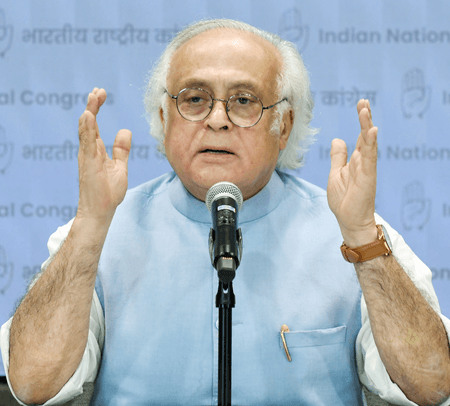
New Delhi, March 19 (IANS) The Congress on Thursday launched an attack on the Centre over a "shockingly high" number of vacancies in the country’s top higher education regulatory bodies, while simultaneously rejecting the proposed Viksit Bharat Shiksha Adhishthan (VBSA) Bill, 2025.
Citing the latest report of the Parliamentary Standing Committee on Education, Congress general secretary (communications) Jairam Ramesh, in a statement, warned that the administrative paralysis in the University Grants Commission (UGC) and the All India Council for Technical Education (AICTE) is being used as a pretext for an "excessively centralised" legislative overhaul.
Ramesh outlined several concerns with the Bill in its present form. He said the ministry had not consulted state governments during its drafting, despite education being in the Concurrent List of the Constitution and the Bill having a direct bearing on State universities.
Referring to the constitutional framework, the Congress leader said the Bill has been introduced under Entry 66 of the Union List.
“However, Entry 66 of the Union List gives limited and specific legislative powers to Parliament, that is, only for ‘co-ordination and determination of standards in institutions for higher education or research and scientific and technical institutions,” he said.
The Rajya Sabha MP argued that the proposed legislation goes beyond this scope and encroaches upon the powers of State governments. Citing constitutional provisions, he added that Entry 44 of the Union List restricts Parliament from legislating on the incorporation, regulation, and winding up of universities, while Entry 32 of the State List vests such powers with State legislatures.
“The Bill is therefore violative of the federal structure of the Constitution,” he said.
Ramesh also pointed to a divergence from the framework envisaged under the National Education Policy (NEP) 2020. He said the policy had proposed a Higher Education Council of India with four verticals, including a separate body for grant allocation.
“Effectively, grant-giving powers will be returned from autonomous bodies (the UGC and AICTE) governed by academics to the Ministry that is run by politicians. This centralisation of power is a departure from current practice and a violation of the NEP,” he said. On governance, the Congress leader criticised what he described as increasing bureaucratisation.
“The new Bill envisages that the executive running of the Commission and the three Councils be done by the member secretaries (i.e., bureaucrats) appointed to them. The administration of education should be done by academics (as is currently the practice) rather than by bureaucrats,” he said.
Ramesh further expressed concern over provisions relating to Institutes of National Importance (INIs), including IITs, IIMs, NITs, IIITs, and IISERs, which have traditionally enjoyed academic autonomy. Referring to Clause 49 of the draft Bill, he said it grants overriding effect over existing laws.
“Although it says that the autonomy of INIs cannot be compromised, it is not clear on the details. Therefore, with this Bill, IITs and other INIs may also be expected to fall under the Commission's regulatory powers. This has never been the case before and may compromise their academic and institutional autonomy,” he said.
Ramesh also contrasted the proposed framework with existing laws governing regulatory bodies.
Under the current UGC Act, he said, the Commission is mandated to determine and maintain standards, frame regulations, and conduct inspections in consultation with universities. “However, the proposed Bill, in contrast, gives sole discretionary powers to the Councils to determine standards, conduct inspection, and exercise or perform other unlimited and unspecified powers and functions. The regulator is now statutorily siloed off from the institutions,” he said.
On technical education, he noted that universities are presently not required to seek approval from AICTE to start new departments or programmes. Under the proposed Bill, however, they would need approval from a newly constituted council to establish campuses.
“It must be remembered that the National Education Policy 2020 calls for greater autonomy to institutes of higher education, not tighter control,” he added.
--IANS
snj/skp