
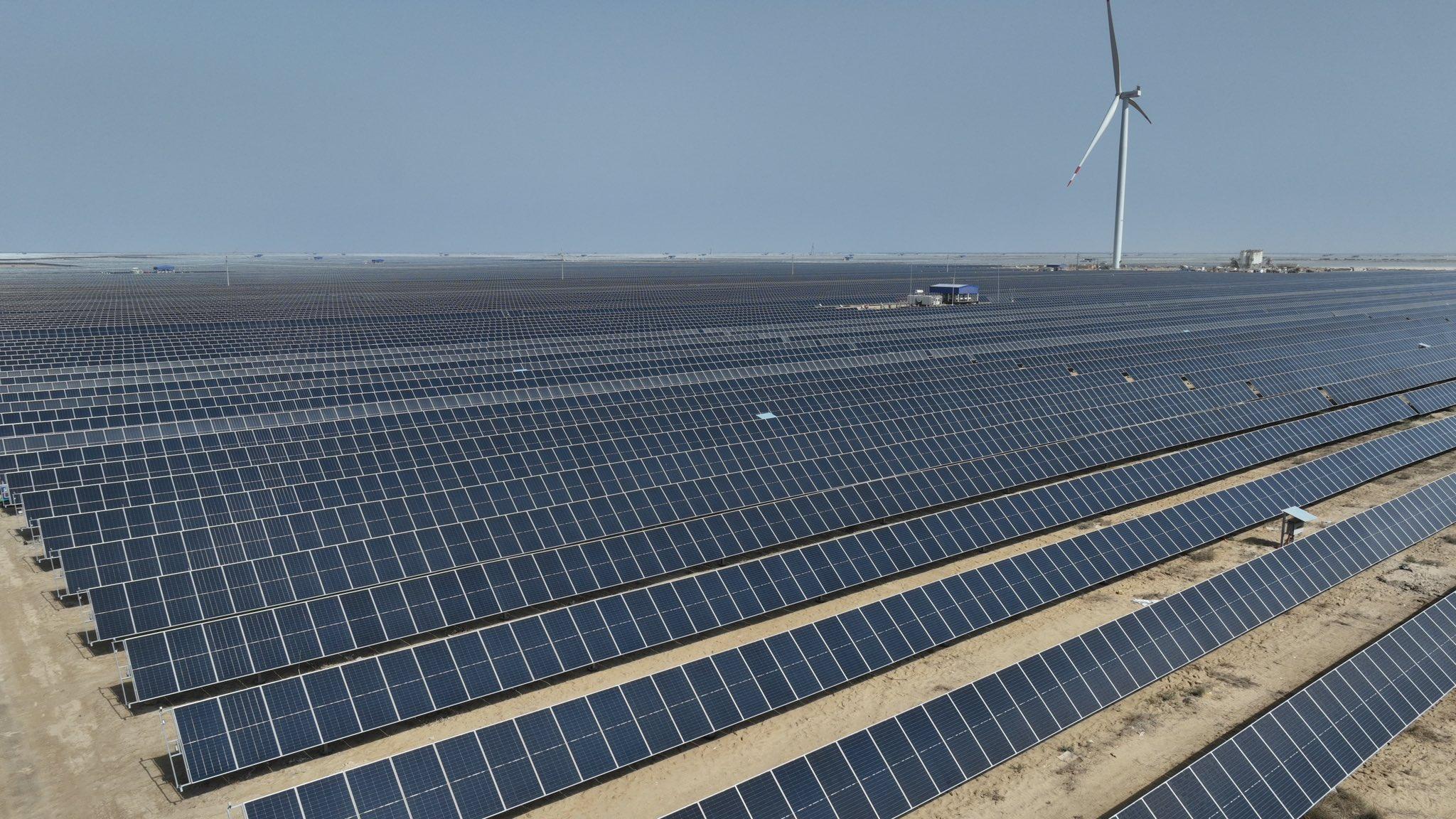
Ahmedabad, Jan 1 (IANS) In December 2025, Chairman of the diversified infrastructure major Adani Group, Gautam Adani, stood in the vast expanse of the Great Rann of Kutch in Gujarat. The landscape was stark. The intent was clear. This was the site of one of India’s most ambitious renewable energy projects. The visit was not symbolic -- it reinforced a strategy centred on scale, speed and execution.
India’s energy challenge is intensifying. The country is home to the world’s second largest population. Its economy is expanding rapidly. Power demand is rising in step. Peak electricity demand grew from around 250 gigawatts (GW) in the financial year (FY) 2025 and is projected to reach nearly 388 GW by FY 2032.
According to the International Energy Agency (IEA), India’s energy consumption will grow 1.5 times faster than the global average over the next 30 years. Power demand is expected to rise by 25 to 35 per cent by 2030. Meeting this demand while decarbonising the grid will require renewables to scale quickly and reliably.
Private sector participation has been critical in this shift. Government policy and clearances created the framework. Execution came from private enterprise. Efficiency, capital, technical expertise and project management have driven the pace of renewable deployment. Large developers have translated policy ambition into operating capacity.
The Great Rann of Kutch reflects this model. The site visited by Gautam Adani is slated to host a renewable energy park with the potential to generate around 20 GW of wind and solar power. In an energy hungry economy, capacity at this scale is transformative. Industry experts increasingly see large contiguous parks as the most efficient path to decarbonisation. Tariffs remain competitive. Vast arid land, strong wind corridors and high solar irradiance make projects like these commercially viable at global benchmarks.
This ambition is backed by capital. The Adani Group has pledged investments of up to $75 billion over five years to accelerate India’s clean energy transition. At a time when global capital is becoming more selective, such long horizon commitments signal confidence. Not only in renewables. But in India’s demand growth and policy stability.
The timing is significant. In 2025, India recorded its highest ever annual renewable capacity addition. By November, more than 44 GW had been added. That is nearly double the pace of the previous year. Solar and wind dominated new installations. Total installed renewable capacity rose close to 254 GW. For policymakers and industry alike, the message is clear. Renewables are no longer peripheral. They are central to India’s power system.
The Adani Group’s strategy aligns closely with this national trajectory. Speaking at IIT (ISM) Dhanbad on December 9, Adani noted that India has crossed the milestone of sourcing more than 50 per cent of its installed electricity capacity from non-fossil fuels. This was achieved five years ahead of the 2030 Paris Agreement timeline. With per capita emissions among the lowest globally, the challenge for India is not growth itself. It is clean and reliable.
Execution remains the differentiator. Through Adani Green Energy Limited (AGEL), the Group has built one of the world’s fastest growing renewable portfolios. In less than a decade since entering the sector in 2016, operational capacity has crossed 17 GW. AGEL is now India’s largest renewable energy company. It ranks among the global top 10. In the first half of FY2026, it added 2.4 GW of capacity. This is the highest addition by any industry player. The company is on track to add 5 GW in the full year and its long-term target is 50 GW by 2030.
The centrepiece of this expansion is Khavda in Gujarat. The 30 GW renewable energy project under construction is expected to become the world’s largest power plant across all energy sources. The site spans 538 square kilometres. That is nearly five times the size of Paris. More than 8 GW is already operational and the project is expected to be completed by 2029.
As renewable penetration rises, storage becomes critical. Power must be dispatchable. AGEL is investing early. A 1,126 MW/3,530 MWh Battery Energy Storage System (BESS) project is under development. It is scheduled for commissioning by March 2026. Once operational, it will be India’s largest and among the world’s biggest single site battery installations.
The company plans to add 15 GW hours (GWh) of battery storage by March 2027. The target rises to 50 GWh over the next five years.
Pumped hydro storage is another pillar. AGEL plans to add over 5 GW by 2030. Construction has begun at Chitravathi in Andhra Pradesh, Tarali in Maharashtra and Gandikota in Andhra Pradesh. The company has also received a Letter of Award from Uttar Pradesh Power Corporation Limited (UPPCL) for 1,250 MW of storage capacity. In Assam, it plans to invest about Rs 15,000 crore in two projects with a combined capacity of 2,700 MW.
Manufacturing integration strengthens the strategy. Through Adani New Industries Limited (ANIL), the Group has built a vertically integrated solar and wind manufacturing ecosystem in Mundra, Gujarat. Adani Solar has 4 GW of capacity. Another 6 GW is under construction. Adani Wind is scaling manufacturing from 2.25 GW to 5 GW in phases.
Together, these elements define the Adani Group’s approach. Speed. Scale. Integration. Patient capital.
As India’s power demand accelerates with urbanisation, digitalisation and industrial growth, such models will be indispensable. Gautam Adani’s December visit to the Great Rann of Kutch captured that ambition clearly. Against a horizon of salt flats and wind, it reflected a future being built decisively and at scale.
--IANS
na/