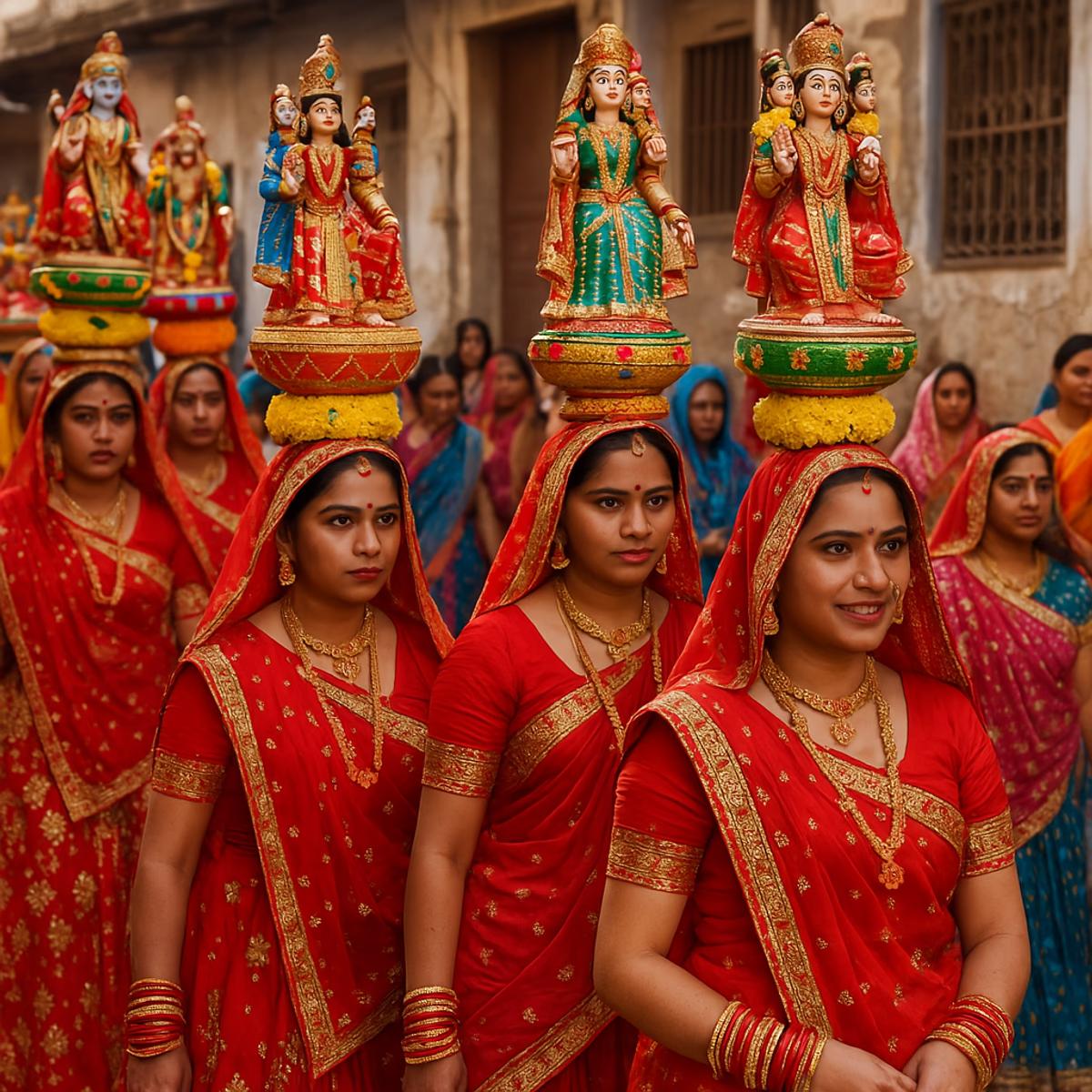
Gangaur is the main folk festival of Rajasthan. The third day of Shukla Paksha of Chaitra month is celebrated with great enthusiasm and zest in the entire state. Apart from Rajasthan, the festival of Gangaur is also celebrated with enthusiasm in Haryana, Malwa, Nimar region of Madhya Pradesh, and Brij, Bundelkhand of Uttar Pradesh and some areas of Gujarat, West Bengal. The people of Rajasthan, whether in any state of the country or abroad, it is their specialty that they are still connected with their folk traditions and follow the folk traditions with full devotion. This is the reason why the festival of Gangaur holds special significance for Rajasthani women. According to religious beliefs, the festival of Gangaur is considered a symbol of worship of Isar (Shiva) Gangaur (Parvati).
Newly Married Women Worship at Their Maternal Home
According to mythological tradition, it is considered necessary for every newly married woman to worship Gangaur on the first Gangaur festival after marriage. The newly married woman comes to her maternal home and worships Gangaur in a group with her friends. During this time, the newly married woman makes these moments memorable and pleasant by laughing, teasing, coaxing and dancing to the tune of folk songs with her friends and women of the family. It is said that a newly married woman worships Gangaur for her Suhaag (husband) and the worship of the teenage girls who worship it is done to get a suitable and handsome groom. The preparations of the young girls and teenagers who worship Gangaur start from Chaitra Krishna Pratipada, the second day of Holi festival. According to the routine, they take bath at 4-5 in the morning and go in groups to collect green grass and water from the stepwell, well or pond. Thus, this routine continues for 16 days spreading the sweet waves of folk songs with love, faith, zeal and enthusiasm.
Idols are made from clay of the wheel
On the day of Shitlashti, young girls dressed in new colourful clothes go to the potter's house to get clay of the wheel and from that clay five idols of Isar and Gangaur and Kaniram, Salan, Rauwa are made. In the folk songs of Gangaur, Birmadatta ji (Brahma) and his two sons Isardas (Shiva) and Kaniram (Vishnu), daughter Rauwa (Rohini) and son-in-law Surya (Surajmal) are also mentioned very beautifully. Young girls also perform the daily ritual of giving water to Gangaur in the afternoon and taking out Banaura at night. Every girl of the group takes out Banaura in turn. She distributes wheat and gram Ghughri as Prasad. And keeps a fast for the Sun God on Sunday.
Folk songs sung during Gangaur Puja
While collecting grass in the morning:
Gardi wala, open the garden, Open the door of the garden, Girls have come, grass is coming...
While worshipping:
Gaur ae Gangaur Mata, open the door, Rowa-saua have come to worship...
After worship:
Gor Gor Gomti, Isar worships Parvati, Parvati’s Aala Tika, Gor’s golden Tika... Married women sing it 16 times, unmarried girls 8 times.)
During Banora at night:
Isardas Ji’s Mandi Gangaur, Bahu Gauran’s Mando Jhumar Kado, Your room has Chandrahaar, Your room has Jhumar Kado...
Farewell to Gangaur
On Chait Shukla Tritiya, Gangaur fairs are held at many places in Rajasthan and Gangaur's procession is taken out with great pomp and show. Especially in Jaipur, Gangaur's procession and fair are worth seeing. On the day of Gangaur's end, young girls wear new clothes and immerse Gangaur in a well or pond while singing folk songs in groups. Young girls consider it as sending Gangaur to her in-laws' house.
The farewell song goes:
Birmadatt Ji, guard your gate, Gaur is now heading home...
In this way, the 16-day celebration filled with love, devotion, and joy comes to an emotional close — keeping alive the cultural heartbeat of Rajasthan.