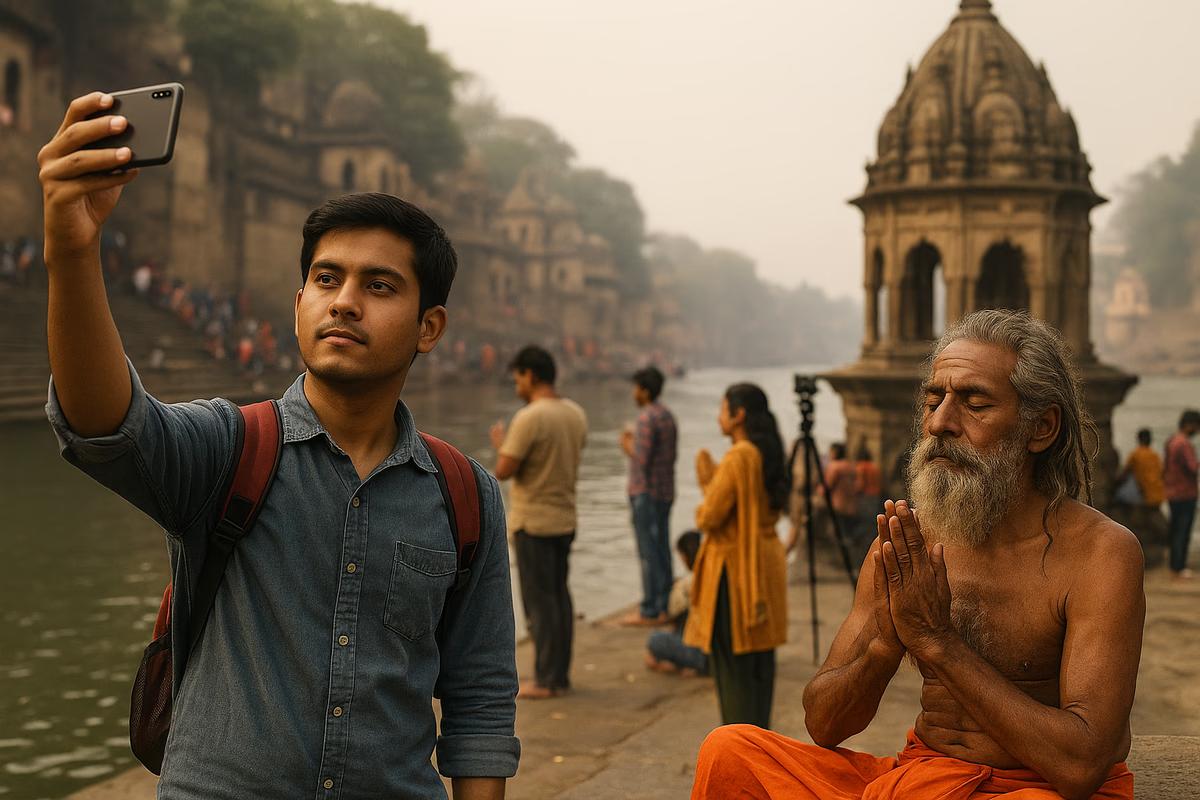
As sacred journeys meet selfie culture, the line between spiritual pilgrimage and recreational tourism fades. In an era where devotion is displayed through filters and reels, this reflection explores how India's ancient practices are being reshaped by digital validation, performative travel, and the growing influence of social media on sacred experiences.
In today’s world, where every moment becomes a “story” and every emotion is filtered through digital lenses, the once clear line between pilgrimage and tourism has become increasingly blurred. We now live in an era where breathtaking views are not seen through the eyes but through the camera lens; where the purpose of travel is not inner peace, but online engagement. A telling anecdote illustrates this shift: a YouTuber once asked a meditating sadhu in Kedarnath what changes he had observed over the years. The sadhu simply replied, “Earlier, people stood before the temple with both hands joined. Now, one hand holds a mobile phone.”
This essay is both a reflection and a reckoning—of how faith has turned into a hashtag, and the path to salvation into a reel.
In a country like India, where pilgrimage has been an act of deep spiritual penance for thousands of years, this was never just a religious ritual—it was a way of life. Places like Kashi, Gaya, Dwarka, Badrinath, Jagannath, Vaishno Devi, Somnath, Vrindavan, and Ayodhya were sacred grounds of self-realization. Devotees journeyed under the scorching sun, barefoot with “kanwars” on their shoulders, chanting only the name of the divine. That was the essence of a true pilgrimage. But today, those sacred journeys are reduced to “vibrant reels” on Instagram. The modern traveler is less concerned with devotion and more with how aesthetic the background looks in the photo.
Tourism, traditionally, has been about joy, entertainment, and cultural discovery. People visited mountains, seas, monuments, and markets to experience something different from their daily lives. However, tourism today has also become performative—“If you didn’t post it, did you really go?”
Under Instagram culture, travel is no longer just about exploration—it’s a digital performance. It is a stage to showcase how much of an “aesthetic traveler,” “free spirit,” or “explorer” you are.
Visit Varanasi today, and you'll find more camera phones than prayer hands at the ghats. At Kedarnath, content creators outnumber the faithful. On the Amarnath trail, you’ll see more travel vlogs than spiritual moments. Pilgrimage sites have become tourist destinations, and faith has become something to be hashtagged. People no longer remove their shoes before entering temples—but they do set up camera tripods. “Selfie with God” has become a prerequisite before actual darshan.
But is this merely criticism, or is it an inevitable stream of change?
Not every change is necessarily bad. Social media has, in many ways, introduced the younger generation to sacred sites they might never have heard of. Many youths today feel inspired to explore these places after seeing devotional content online. When someone shares a photo immersed in Shiva’s devotion at Kedarnath, it may not just be for show—it can be a genuine digital expression of reverence.
The real issue arises when the purpose of the journey changes. If a pilgrimage is undertaken only for beautiful pictures and reels, and if faith is just for online display, then it is no longer a pilgrimage—it’s tourism. And if tourism becomes a means solely to impress others, it loses its authenticity and becomes performance. Pilgrimage was once a silent experience, one that took you inward. Today, it has turned into a cinematic experience—with DJ bhajans, drone shots, and full cinematic edits. The feelings that once arose within the heart are now simulated through editing apps.
When the goal of the journey is not spiritual fulfillment but social validation, it creates a crowd—not of devotees, but of performers. And this crowd impacts the sanctity of religious places. Litter, noise, lack of discipline, and commercialization are now common sights at pilgrimage sites. Instagram trends have turned many such places into tourism hubs. Hotels, cafes, “Insta-friendly corners,” and grand gateways have become the new identity of pilgrimage centers. Outside temples, you now see photo booths labeled “#ShriRamZone” or “#HarHarMahadevSpot.”
Ignoring this shift is pointless—but regulating it is essential. To prevent pilgrimages from being reduced to tourist outings, religious places must establish their own codes of conduct. Restrictions on camera use, prohibitions on photoshoots inside temples, and promoting silence, discipline, and cleanliness should be made standard. The purpose of travel should be inspiration, not promotion.
Instagram culture has brought visual richness and shareability to our travel experiences, but it has also made spiritual experiences shallow. Pilgrimage is the hunger of the soul, whereas tourism is pleasure for the mind. If we view the sacred only through a camera lens, we risk losing its essence. Pilgrimage is something to be felt, not just shown.
So next time you embark on a pilgrimage, take a photo—but also take a moment to journey inward. Because there, you’ll find no filter—only truth.