
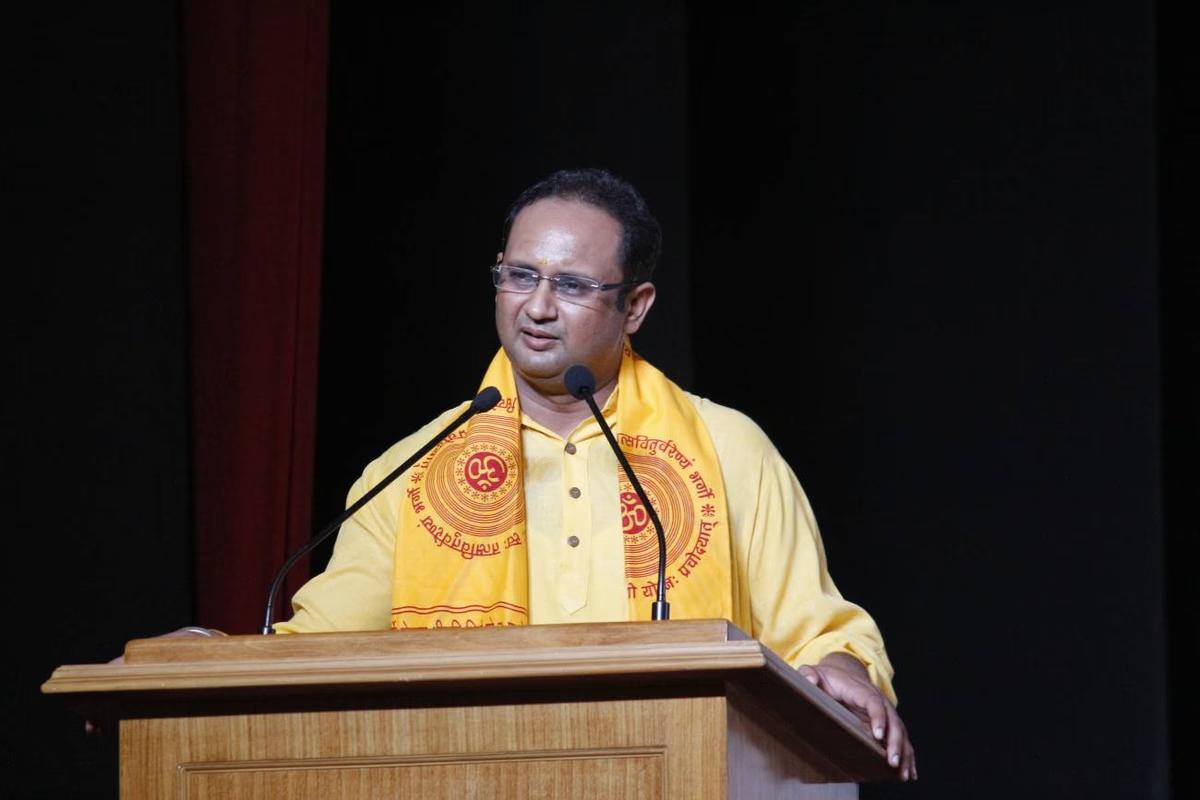
As the All World Gayatri Pariwar celebrates its centenary year this month from 19th to 23rd January, we engage with Dr. Chinmaya Pandya, MRCP(UK), who returned to India responding to his inner call quitting the service as as Consultant in West London Hospital Trust, London and joined Dev Sanskriti University's leadership team as a Pro-Vice Chancellor. The grandson of Pandit Sriram Sharma Acharya, the Guru who founded Gayatri Parivar, Dr Chinmaya Pandya considers himself only a representative disciple of the thought revolution movement initiated by Pt. Sriram Acharya. He says that if India is to regain its true form of being a Vishwa guru, every Indian should study their knowledge in depth and not just rely on the floating messages on social media.
The Humble Beginning
In 1926, in a small hut of Anwalkheda village in the Agra district of Uttar Pradesh, Pt. Ram Sharma Acharya manifested the eternal lamp of spiritual renaissance. He performed the 24 great purifications of Gayatri, with the sole objective of awakening divinity in humanity, and this laid the foundation of the Gayatri Pariwar and Shanti Kunj. Now this All World Gayatri Pariwar has become a global community with over 150 million adherents worldwide.
The Noble Objective
The sole objective of the foundation is that humanity should recognize its own inherent divinity that God resides within our inner consciousness. Just as the Gems are in the mines, but they are found only after digging; grain is in the earth, but it can satiate our hunger only after plowing from the field. Similarly, God is within man, but He is found only after awakening. Kabir Das Ji's famous saying goes, "Just as oil is in the sesame seed, and fire is in the flint, your Lord is within you; awaken if you can." Pt Ram Sharma Acharya undertook this work of awakening.
On Bharat Becoming A Vishwaguru, The World Leader
India's knowledge, wisdom and science are amazing, but today’s younger generation is unaware of its heritage, hence the proclamation of being a Vishwa guru seems to be farfetched. When I was a little child of eight years, an incident of meeting my Guru changed my life. I approached my Guru with a doubt while reading a scripture. My guru, who wrote 3400 books, said, "Son, don't reject something without reading it." And I think that's very valuable for today's times, first understand, then believe. And from this perspective, many people say that it is written in the scriptures, but have you actually read it? Have you read what's written in the Bhagavad Gita? Have you read what is written in the Upanishads? When one reads, one gets closer to God, one’s self-respect is strengthened. And lastly you are able to determine the nature of your own truth; it is not something given by someone else. If I feel thirsty, I will drink water myself. I won't tell someone else to drink water. So, when I have a hunger for knowledge, I should search for it myself. So I would say that if India is to regain its true form, every Indian should study their knowledge in depth.
Growing Craze Of Social media Rather Than Books
With the advent of social media, the chaos has increased even more. The generation born after 1995, which we call Generation Z or Zoomers was the first generation in the world to get smartphones as they entered their teenage years. The iPhone came out in 2007, by 2009, likes and tweets had arrived, by 2010, front-facing cameras were available, and in 2012, Facebook bought Instagram. So not only was I forced to post about my life, but I was also forced to be judged by others. Our social acceptability is no longer determined by toys and games, but by YouTube videos and Instagram reels. If I get likes, then I am right otherwise, my opinion is wrong.
Being Opinionated, Moving From Real To Artificial Life
Life has moved from real to artificial. Now, when we form an opinion about someone, we do it based on their online life, when people present themselves in a certain way, and we form our opinions based on what they show us. So, integrating artificial intelligence with spirituality is very essential, otherwise, it will be disastrous. We say that we are working hard on the horses, but not on the horse riders. Our concern is that a lot of effort is being put into technology, but the same amount of effort needs to be put into those who will operate it. If they don't operate it properly, the horses will go anywhere and won't take you to your destination. So, it needs to be controlled, disciplined, and most importantly, it must be useful for humanity.
Spending Almost A Decade in Europe, Returning To India
I was a consultant at Cambridge but as a representative of Shanti Kunj, I gave three speeches at Trinity College. We don't consider ourselves mere instruments, rather, we have complete faith that whatever exists belongs to Him. And I think that calling was so profound, and his faith in us was so strong, that because of it, we never even considered any other option. I have been there for 9.5 years. My inner call brought me back to Bharat, the sacred land.
The Major Challenge
The major challenge which the humanity confronts today is emotional reconstruction. From today's perspective, the problem in simple terms is that the means of happiness have increased, but individuals, character, personality, mutual love, affection, and trust have become narrower. Relationships are also breaking down frequently. Broken down, the individual was already detached from purpose; from the perspective of families, the sense of family continued to shrink. First, it was that the whole village was our family, then it became that only my house in the village was my family, then it became that even within the house, only my immediate family was my family. It became increasingly narrow, and the root cause behind this is that we have instilled in the heart of the individual the idea that my self-interest is paramount above all other purposes in the world. I want what I want now, at this very moment, at any cost, even if it means strangling someone else. So, the purpose Gurudev gave was this: the external world is like a mobile phone, but it is switched off. It needs to be switched on. When the individual's emotions change, even a misguided person becomes divine.
The Awakening
Gurudev made Shanti Kunj the center for that purpose, laying three foundations: Upasana (worship), Sadhana (spiritual practice), and Aradhana (devotion). Upasana doesn't merely mean calling out to God, but rather embodying the qualities of God. Gurudev used to give the example that if you go near a transformer, perform a puja, and return home, you won't get electricity. You have to lay the wires. Similarly, if we go to God and only perform worship and rituals, the divine qualities will not be incorporated within us. Their establishment in the heart is essential. Nowadays, religion has been limited to this: just performing rituals, going to the temple, going to a pilgrimage site, and coming back. But by coming to Shanti Kunj Gayatri Tirtha, a complete transformation takes place here. Spirituality is refinement which comes with regular practice.
Shantikunj’s role in India becoming a Vishwaguru…
Upasana (worship), Sadhana (spiritual practice), and Aradhana (devotion) are the three methodologies adopted in Shantikunj. The purpose of Upasana is to imbibe divine qualities. Sadhana means refining one's life, just as a horse is trained and becomes disciplined. Shanti Kunj is preparing such sadhaks who are completely self-disciplined and then useful to society. When one family improves, the society improves and India as a nation will automatically become a Vishwaguru. Shanti Kunj's objective is to showcase the profound knowledge and science of India. There is no field of study where we can go and not find India's contribution; the highest level of thought originated in India.