
New Delhi, April 2 (IANS) Round-the-clock monitoring and calibrated response must for India to stay prepared and deal with any eventuality amid the evolving West Asia crisis, Defence Minister Rajnath Singh said on Thursday.
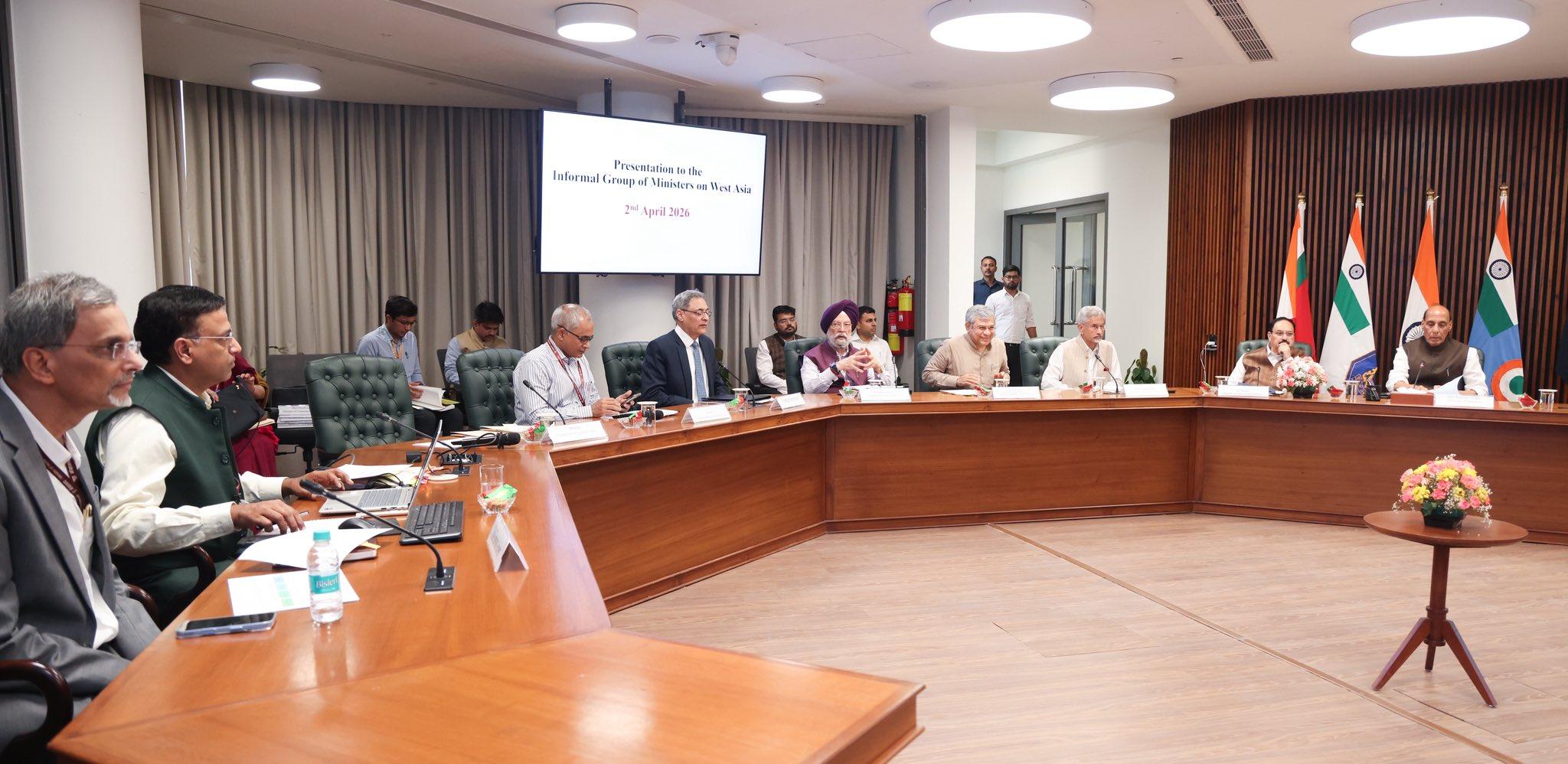
The second meeting of the Informal Group of Ministers (IGoM), set-up to monitor the evolving situation in West Asia and suggest proactive measures for its minimum impact on India, was held under the chairmanship of Rajnath Singh here.
The meeting deliberated upon the recent developments at length, and the next steps to be taken by the Government to mitigate any adverse impact arising due to the ongoing conflict.
In view of the “uncertain situation”, Defence Minister underlined the importance of round-the-clock monitoring of the situation and the need to respond in a calibrated manner to deal with any eventuality.
He stressed on the need to leave no stone unturned to ensure that the people of the country face the minimum effect of the conflict.
The seven Empowered Groups of Secretaries briefed the IGoM on the steps being taken to tackle the situation.
It was apprised about measures undertaken by the Ministry of Finance to address concerns arising due to global trade disruptions and provide relief and support to the industry, especially manufacturing, and bolster investor confidence.
These include full customs duty exemption on 40 critical petrochemical products till June 30, 2026; announcement of a special one-time relief measure for eligible units in SEZs to sell manufactured goods in Domestic Tariff Area (DTA) at concessional customs duty rates to be effective from April 1, 2026 to March 31, 2027; and that the provisions of GAAR will not be invoked in respect of investments made prior to April 1, 2017.
These measures will reduce cost pressures on downstream sectors including textiles, packaging and pharmaceuticals, facilitate supply stability in the country and provide requisite clarity for investors contemplating investments in India, according to an official statement.
Rajnath Singh appreciated the Government’s decision to impose a 25 per cent cap on the monthly increase in Aviation Turbine Fuel prices for domestic operations, with effect from April 1. This step will help protect the people from sudden increase in fares.
The Government has accorded highest priority to domestic LPG supply, with refinery production enhanced to fully meet consumption requirements. The IGoM was informed that there have been no reports of dry-out at LPG distributorships, and delivery of domestic LPG cylinders continues as per the normal schedule.
The temporary supply concerns arose due to instances of hoarding and black marketing, which triggered panic buying in certain areas.
To support migrant labour and low-consumption households, the Government is ensuring adequate availability of 5 kg Free Trade LPG cylinders, and since March 23, 2026, over 4.3 lakh such cylinders have been sold. Special focus is being given to States where demand is higher.
The IGoM was apprised that industrial requirements dependent on commercial LPG are being met, with over 80% of pre-crisis supply levels being maintained to ensure continuity of operations.
Special meetings have been held with ministries and stakeholders of different industries to understand their demand and meet their needs. Oil PSUs are ensuring continued supply of Auto LPG across the country.
The Ministers were informed that the number of LPG deliveries per day has been increased significantly to cater to the surge in demand caused by panic buying, ensuring that there is no shortage for consumers.
Piped Natural Gas (PNG) is being actively promoted for industrial use as a reliable alternative, wherever feasible. PNG supplies for industrial usage are being ensured in sectors where it is already in use, maintaining operational continuity.
—IANS
na/