
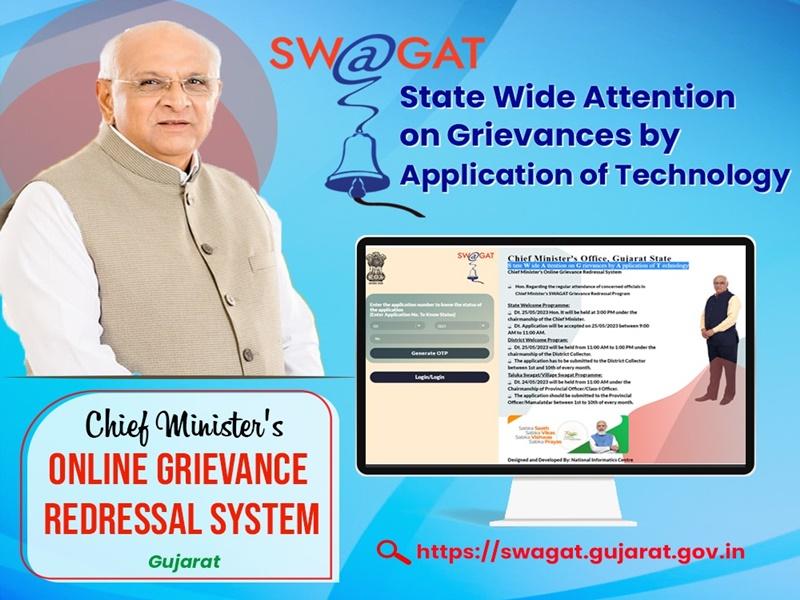
Gandhinagar, Jan 1 (IANS) The SWAGAT (State-wide Attention on Grievances by Application of Technology) programme, launched two decades ago in Gujarat, has played a pivotal role in strengthening citizens' trust in governance and has achieved several key milestones over the years.
According to official estimates, more than 99 per cent of applications, comprising citizens’ complaints and grievances, have been resolved through the SWAGAT platform over the past two decades, marking a landmark achievement for the pioneering initiative.
Under SWAGAT 2.0, citizens' grievances are addressed within a stipulated timeframe, with periodic reviews conducted to assess officials' performance.
The ground-breaking scheme was first launched by the then Chief Minister Narendra Modi in April 2003, to bridge the gap between citizens and the government through extensive use of technology.
The aim of the programme was simple yet powerful -- to enable citizens to present their grievances directly before the highest levels of government without fear, delay or procedural hurdles.
Over the last two decades, the scope of the SWAGAT programme has expanded to districts, talukas and villages. Today, the initiative is being steered by Gujarat Chief Minister Bhupendra Patel.
Since its inception in 2003, the SWAGAT platform has consistently strengthened public trust in the state government. Official data shows that 99.10 per cent of applications received over the last 22 years have been positively resolved.
SWAGAT 2.0 and Auto Escalation Matrix System
Designed as an active and people-centric platform, SWAGAT has evolved over the years in line with technological advancements.
Under the guidance of Chief Minister Bhupendra Patel, the SWAGAT 2.0 Auto Escalation Matrix System was implemented across all districts and departments of the state on December 25, 2024, coinciding with the launch of the SWAGAT online mobile application.
The system was initially rolled out as a pilot project on December 25, 2023, on the occasion of Good Governance Day, covering the Revenue and Panchayat Departments and the districts of Patan and Kheda.
Following the pilot launch, out of a total of 21,540 applications received, nearly 90 per cent were qualitatively resolved within the stipulated timeframe. Encouraged by the success, SWAGAT 2.0 was expanded statewide on Good Governance Day, December 25, 2024.
The modern SWAGAT framework is built around an automatic escalation mechanism to ensure grievances do not remain pending at any level. Time limits have been defined for qualitative resolution of issues, with applications routed online to the concerned officers.
If a grievance is not resolved within the stipulated period, it is automatically escalated to the next higher authority. Applicants receive SMS updates at every stage, from registration to final resolution, while unresolved cases are closely monitored by the Chief Minister’s Office.
Monitoring dashboards and policy impact
To ensure the timely disposal of grievances, multiple monitoring dashboards have been developed. A performance dashboard is also used to evaluate officials' responsiveness and efficiency.
These dashboards provide insights into the types of grievances most frequently received across districts and help identify policy-level interventions required at the state level.
Several policy decisions have been shaped through the SWAGAT platform, particularly in areas concerning farmers, land acquisition, students, encroachment on gauchar (pasture) land, re-survey issues and policing.
Farmers' long-pending issue resolved
In a notable case, a decades-old problem faced by farmers in Moddar village of Kutiyana taluka in Porbandar district was resolved through the SWAGAT mechanism.
For nearly 40 years, farmers had to travel an additional 15 km due to the absence of a bridge over the Sukhbhadar River between Moddar and Pasavari.
A local resident, Lakhmanbhai Navghanbhai Modedara, raised the issue at the taluka and district levels before it was finally taken up under the State SWAGAT platform.
The grievance highlighted the difficulties faced by 118 farmers cultivating around 3,600 bighas of land. Following the representation, the Chief Minister directed the Roads and Buildings Department and the Porbandar Collector to expedite the project.
An all-weather road, along with a minor bridge, culverts and a 3-km stretch connecting Moddar and Pasavari, is now set to be constructed at an estimated cost of Rs 9 crore.
--IANS
mr/pgh/skp