
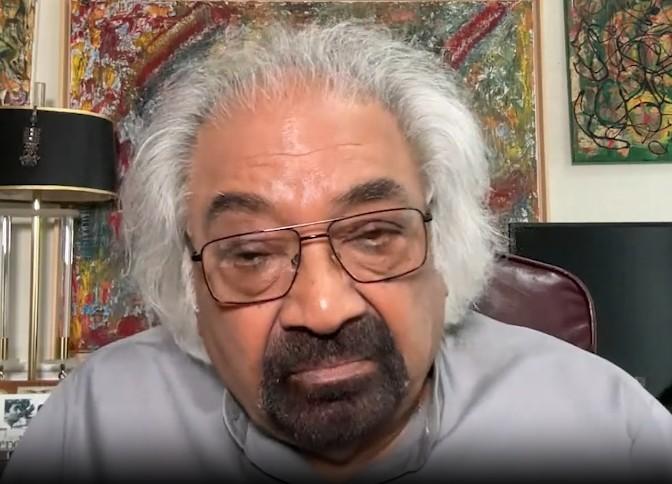
Washington, April 2 (IANS) Indian Overseas Congress chief, Satyanarayan Pitroda, popularly known as 'Sam', on Thursday welcomed the BJP-led NDA government's announcement that Naxalism has almost been eradicated from India. However, he asserted that it is essential to understand the "root cause of Naxalism".
Speaking to IANS, Pitroda also said that while he has "trust deficit" with the current electoral process in India, in the future, voting will take place on mobile phones using blockchain and Artificial Intelligence.
Here are some excerpts from the interview:
IANS: The Indian government now claims to have effectively eliminated Naxalism from the country. Your take on it?
Pitroda: I believe in dialogue, I do not believe in force, I have never believed in force, but you know some of these problems are very complex. I mean this has been going on for 50 years. I know a little bit about Naxals because I have studied (about it) in my youth.
If you go to the root cause of it, you have to understand why these people took to arms, not that I am justifying that. But I think you have to look at things from everybody's angle, and not just your angle. You got to have some empathy, you got to go in other people's shoes to take the walk they have taken, and that is what Mahatma Gandhi was all about.
So, I am glad there is no violence, no fear, but then at what cost? How did it happen? Very complicated issue.
IANS: Assembly elections are taking place in Kerala, West Bengal. What are your expectations?
Pitroda: I have my concerns about free and fair elections in India. Something is not right with the whole process, whether it is EVM, VVPAT, electronic tampering, software modifications, voter lists, video recording, when you put the entire process together, you find that there are many different points where you can manipulate. I believe some of it is happening. How much of it, where, is difficult to pinpoint, because there may not be one thing at one place, but there may be something else, somewhere else. So, I'm not convinced that elections in India are free and fair. I've lost trust. This trust deficit bothers me more than anything else.
IANS: How do you make those concerns more evidence-based? In the same elections, in some states ruling party is winning, in others Opposition parties are winning...?
Pitroda: It is not about winning or losing, because you can manipulate any way you want. It can be, this state is small so let you win. If the state is too big, important, we don't let you win. Let's say, Maharashtra where lot's of money is involved, we don't let you win. It is an example, I am not saying this is what happened.
So there is a trust deficit. Unless and until we bridge this trust deficit, it is difficult for me to say one way or the other.
Recently when I was in Germany, we were told that Germans came to a conclusion that Electronic Voting Machines cannot be trusted. So, the German Supreme Court decided that we will keep paper ballot. It maybe a traditional but a trusted process.
IANS: Being an engineer you know every technology evolves over a period of time, it has its own ups and downs. What do you think can be the improvements?
Pitroda: From a distance, I would say, unless and until you give me a paper receipt and let me drop it in a box which is not electronically connected, you cannot get my trust.
IANS: But then the ballots are going to be counted by someone else.
Pitroda: True, I can still have those papers counted again to verify. Today, I have nothing to verify.
IANS: Do you think we can come up with a technological solution to this in the age of Artificial Intelligence (AI), blockchain?
Pitroda: Of course. I'm one of those who also firmly believe that future voting is going to be on mobile phones with blockchain, highly secured. There is always 0.1 per cent error here and there. That's okay. That's part of the game. But that will be convenient. People don't have to go to booths. There is no booth management. There is no police. There are no lines. You know, that's the future.
If given an option, I would say we should scrap the current e-governance in India and redesign current e-governance. Redesign processes so that AI becomes effective. AI should be used to really reduce the size of the government. But you can't talk like that because everybody will be upset at you.
I am willing to question things like 'do I even need a degree anymore'? Why do I need four-degrees anymore because all the knowledge is available at my fingertip. The knowledge today is such that you have universal access but you are not trained to think differently for that knowledge.
Like, teachers are obsolete in the age of AI. I want a mentor. But today's teacher is not trained to be a mentor.
I want to eliminate hunger and poverty using AI. It is a dream but it can be done. You need political will for that.
So, AI is an opportunity for India to solve big problems.
--IANS
cg/rad