
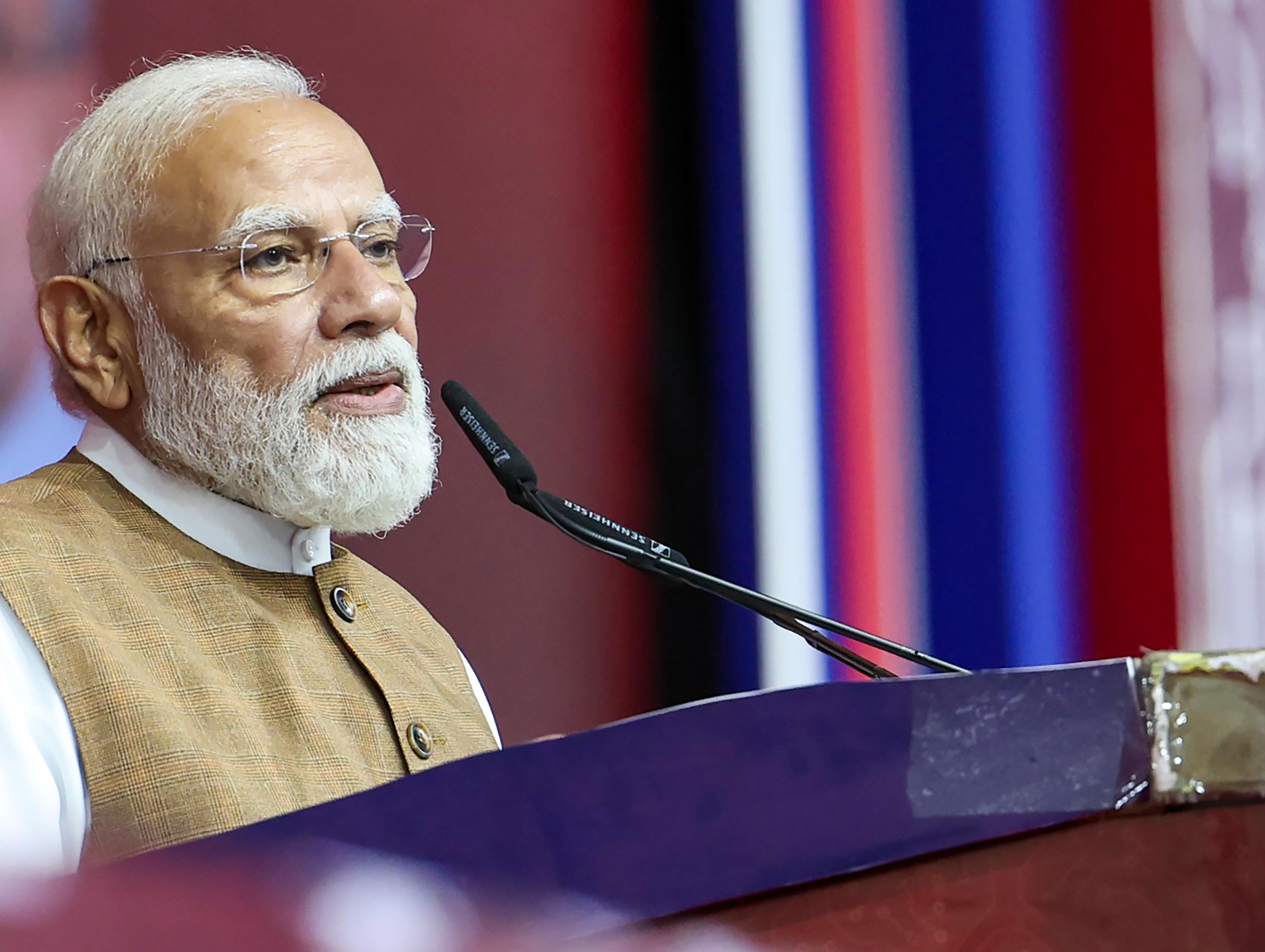
Sanand (Gujarat), March 31 (IANS) Prime Minister Narendra Modi said on Tuesday that the start of production at Kaynes Semicon's OSAT facility in Sanand demonstrates the speed and growth of India’s semiconductor ecosystem and its increasing integration with global supply chains.
Speaking at the inauguration of the plant, the Prime Minister noted the close timing of developments in the sector.
“On February 28, production began at Micron Technology’s facility, and today, on March 31, production will start here at Kaynes,” he said.
“This is not a coincidence but proof of the speed of India’s semiconductor ecosystem.”
He recalled his visit to Sanand at the end of the previous month, saying, “I was in Sanand on the last day of last month, and today I am here on the last day of this month as well.”
He added, “Earlier today, I attended a ‘divine’ programme, and now I am present at a ‘digital’ programme.”
PM Modi said it is encouraging that an Indian company has entered semiconductor manufacturing.
“I am pleased that an Indian company has shown interest in making semiconductor chips, and Kaynes will become a participant in the global supply chain,” he said, adding that in the coming days, many Indian companies will collaborate globally to build resilient semiconductor supply chains.
He said the initiative aligns with “Make in India, Make for the World” and strengthens India’s role in the global market.
Describing the development as a “new bridge between Sanand and Silicon Valley,” he said the plant will supply Intelligent Power Modules (IPMs) to a California-based company.
“A major chunk of the chips being produced is already booked for exports,” he said.
The Prime Minister noted that modules manufactured in Sanand will reach US companies and contribute to global industrial and electric vehicle ecosystems.
“These Intelligent Power Modules will give strength to the electric vehicle ecosystem and heavy industries in India and across the world,” he said, calling the global partnerships “the strongest foundation for the world’s better future".
Set up with an investment of about Rs 3,300 crore, the facility is an outsourced semiconductor assembly and test (OSAT) plant with a planned production capacity of 6.3 million units per day.
PM Modi highlighted India’s domestic capabilities, mentioning the development of advanced microprocessors such as 'Dhruv64' for sectors including 5G infrastructure, automotive electronics and industrial automation.
He also described efforts to build a skilled workforce, noting that more than 85,000 design professionals will be trained, over 400 universities and start-ups have access to advanced design tools, and more than 55 chips have been designed.
He said India’s semiconductor market is currently valued at $50 billion (Rs 4 lakh crore) and is expected to exceed $100 billion (Rs 9 lakh crore) by the end of the decade.
“Our target is to make most of our required chips in India,” he said, adding that the country is working to improve ease of doing business, manufacturing and logistics, while promoting innovation in AI and expanding private sector participation in the space sector.
--IANS
mys/uk