
Ranchi, Jan 1 (IANS) While January 1 is celebrated across the world as the beginning of a new year, the day remains a symbol of grief and sacrifice for Jharkhand's Kharsawan. Seventy-seven years ago, on January 1, 1948 -- a few months after India attained independence -- the soil of Kharsawan was soaked in blood during a brutal firing on tribal protesters, an incident often compared to the Jallianwala Bagh massacre.
On that fateful day, thousands of tribals had gathered to oppose the proposal to merge the princely states of Kharsawan and Seraikela with the then Orissa. The protest was triggered by the demand for a separate state, and was met with indiscriminate police firing, leaving scores dead.
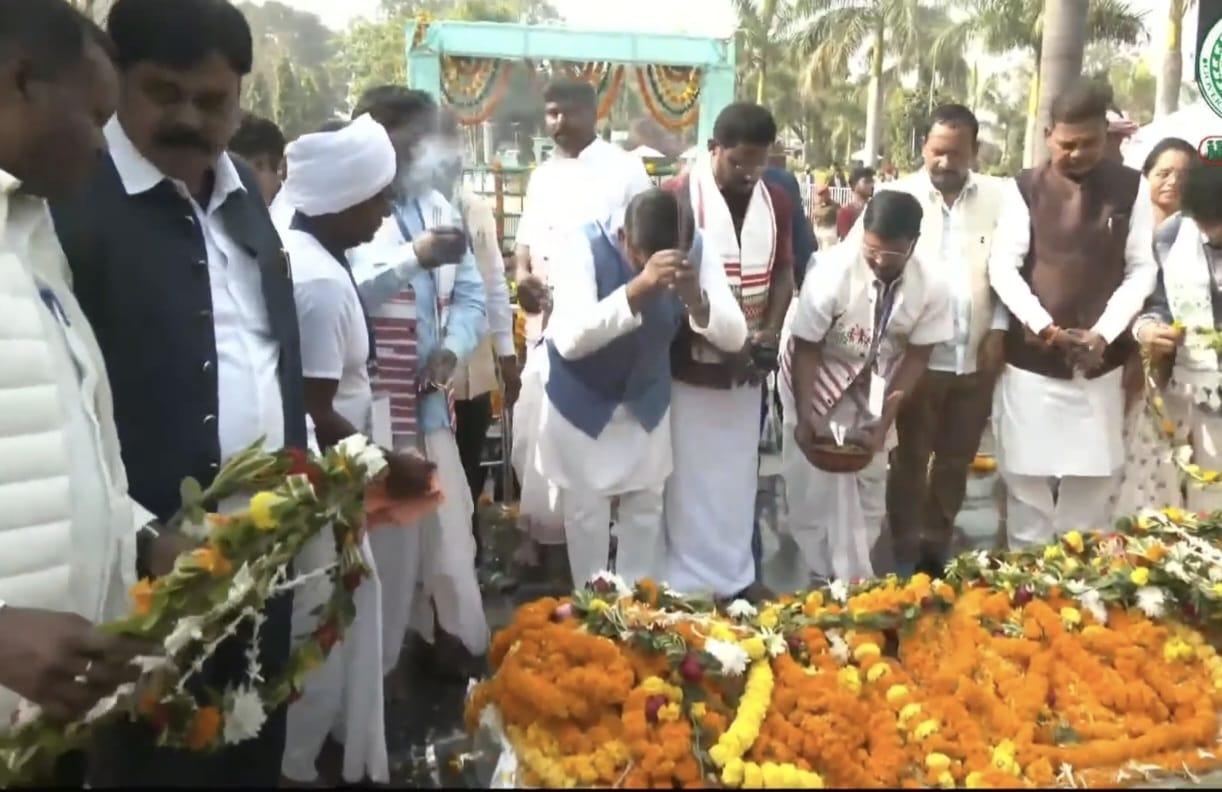
As every year, large numbers of people assembled at the Martyrs’ Memorial in Kharsawan on Thursday to pay homage to those who laid down their lives.
Jharkhand Chief Minister Hemant Soren, former Chief Minister Arjun Munda, Minister Deepak Birua, Singhbhum MP Joba Majhi, Chakradharpur MLA Sukhram Oraon, Kharsawan MLA Dashrath Gagrai, and Ichagarh MLA Sabita Mahato were among the leaders who visited the memorial on Thursday morning and paid floral tributes.
The Chief Minister announced the formation of a judicial panel to identify and honour those martyred during the massacre.
After paying tribute, Soren said: "Today is Martyrs’ Day as well as the first day of the year. For the world, it is New Year’s Day -- a day of celebration. But for the tribals, indigenous people, farmers, and labourers of Jharkhand, January 1 is Martyrs’ Day. Jharkhand is steeped in the history of sacrifice; perhaps no other state has witnessed so many martyrs."
"A draft has been prepared for this purpose. A judicial inquiry commission will be constituted, with retired judges as its members. The martyrs of this firing will be honoured before the next Martyrs’ Day," he said.
The firing was linked to the reorganisation of princely states following Independence. A proposal to merge Kharsawan and Seraikela with Orissa had triggered strong opposition from the local tribal population, who instead demanded a separate state. To press their demand, a massive public meeting was organised at the Kharsawan Haat ground on January 1, 1948, under the leadership of renowned tribal leader Marang Gomke Jaipal Singh Munda.
Tribal activists from Jamshedpur, Ranchi, Chaibasa, Simdega, Khunti, Tamar, and other areas had gathered in Kharsawan to participate in the meeting. However, Jaipal Singh Munda could not reach the venue for some reason.
Subsequently, the gathering decided to proceed towards the Kharsawan royal palace to convey their demands to the king. Anticipating unrest, the Orissa government had deployed a heavy police force.
As the crowd moved towards the palace, police issued warnings to stop. When these warnings went unheeded, the police opened fire indiscriminately on the unarmed protesters.
The Kharsawan firing is remembered as one of the most brutal episodes of repression in the history of India’s tribal movements.
In a speech delivered on January 11, 1948, Jaipal Singh Munda recounted that bodies were strewn across the Kharsawan market area, while the wounded cried out for help and water.
He alleged that the administration sealed off the area, preventing entry or exit, and that by evening, bodies were loaded onto trucks and disposed of in forests and rivers.
Even after more than seven decades, the exact number of those killed in the firing remains unknown. The report of the tribunal constituted to investigate the massacre has also not been made public to date.
--IANS
snc/skp/vd