
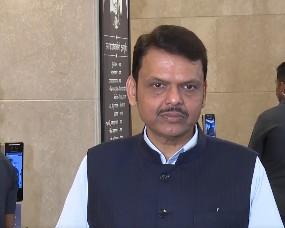
Mumbai, March 16 (IANS) Maharashtra Chief Minister Devendra Fadnavis, on Monday, defended the state government's move to introduce the Maharashtra Freedom of Religion Bill, which aims to curb unlawful religious conversions in the state.
He said the Bill was presented especially when there have been several instances where women were allegedly lured into relationships, married and later abandoned.
"There have been many cases where women were lured, eloped and they were abandoned after marriages. In such situation, it raises the question of their child from such relationship. It complicates their life. The Bill is trying to find out solutions to such problems," Chief Minister Fadnavis told reporters.
However, he did not provide any data supporting his claim.
He said that if the opposition parties had read the Bill carefully, they would realise that it does not target any community but is aimed at preventing forceful religious conversions carried out through inducement, coercion or pressure.
"The Opposition is merely trying to politicise the issue for their vote bank politics. I can guarantee you that after careful reading of the Bill, the Opposition will not object to it," he added.
Chief Minister Fadnavis said that Maharashtra was not the first state to introduce such a legislation and several states had already enacted similar laws to curb unlawful religious conversions.
The state government had tabled the Maharashtra Freedom of Religion Bill, 2026, in the State Assembly on March 13, seeking to prohibit unlawful religious conversions carried out through force, coercion, allurement, misrepresentation or other fraudulent means.
Maharashtra Minister of State for Home, Pankaj Bhoyar, on March 13 introduced the Bill, which aims to protect the right to freedom of religion while regulating religious conversions and providing punishment in cases of unlawful conversion.
According to the Bill, individuals intending to convert must provide a 60-day advance notice to the district authorities. Following the conversion, the change must be officially registered within 25 days to be considered legally valid.
The Bill has also proposed that blood relatives of a person being converted to another religion can file a complaint if they suspect the process involves force or inducement.
Section 14 empowers the state to ban and fine organisations found guilty of facilitating or funding illegal conversions.
Section 9 outlines the judicial consequences for offenders with imprisonment up to seven years of rigorous jail time and a penalty of up to Rs 5 lakh.
The Bill has proposed stringent administrative requirements and criminal penalties to ensure that religious conversions are a matter of personal choice rather than coercion.
Under the proposed legislation, any person intending to convert from one religion to another, as well as any individual or institution organising a conversion ceremony, must give a notice at least 60 days in advance to the competent authority, defined as the District Magistrate or an officer authorised by the state government.
The competent authority will publicly display details of the proposed conversion at its office and at the village panchayat or local authority concerned, inviting objections from the public within 30 days.
The Bill further mandates that the converted person and the individual or institution organising the ceremony submit a declaration to the authority within 21 days after the conversion.
It also allows parents, siblings or relatives related by blood, marriage or adoption of the converted person to lodge a first information report (FIR) if they suspect unlawful conversion, and requires the police to register such complaints.
The burden of proof that a religious conversion did not violate the provisions of the law will lie on the person who caused, assisted or abetted the conversion, the Bill said.
--IANS
sj/khz