
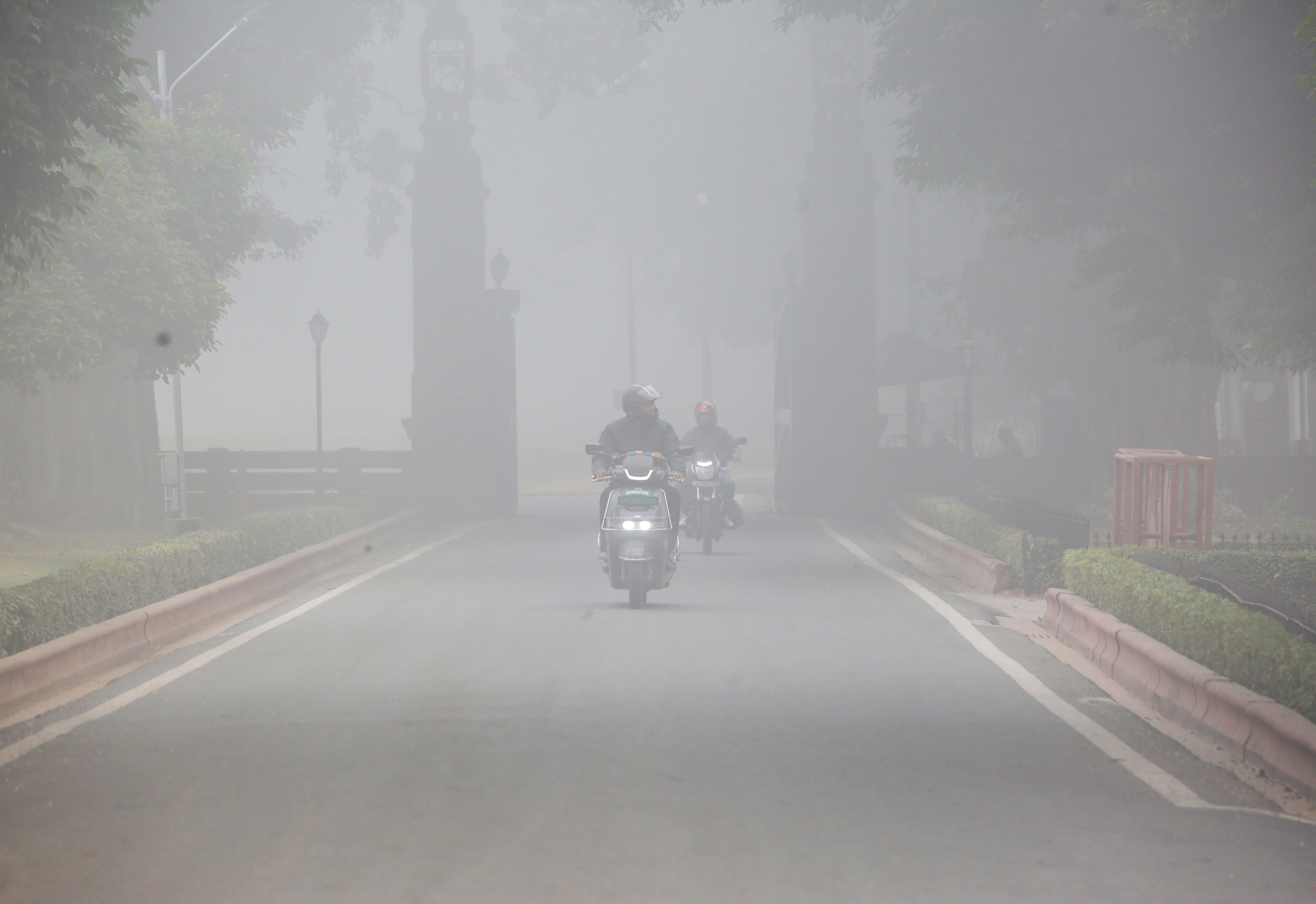
New Delhi, Dec 17 (IANS) Delhi experienced a slight improvement in air quality on Wednesday, aided by relatively strong surface winds, though pollution levels continued to remain in the ‘very poor’ category.
Shallow fog was also observed across several parts of the city during the morning hours. According to official data, the national capital’s average Air Quality Index (AQI) stood at 328 at 8 a.m., an improvement from 354 recorded at 4 p.m. on Tuesday.
The India Meteorological Department (IMD) reported reduced visibility in parts of the city. Safdarjung recorded the lowest visibility at 900 metres, while Palam witnessed visibility of around 1,100 metres under misty conditions. The IMD added that steady winds blowing at speeds of 7-10 km per hour during the early hours helped disperse pollutants to some extent.
Despite the marginal relief, pollution levels are expected to remain high in the coming days. According to the Centre’s Air Quality Early Warning System (EWS) for Delhi, air quality is likely to stay in the ‘very poor’ category from December 17 to December 19. From December 20 onwards, the outlook for the subsequent six days suggests that AQI levels may fluctuate between the ‘very poor’ and ‘severe’ categories.
Several monitoring stations across Delhi reported alarming pollution levels. Bawana recorded the highest AQI at 378, followed by Mundka at 370, Pusa at 365, and Rohini at 364. Areas such as ITO, Wazirpur, and Nehru Nagar recorded AQI values between 360 and 361, while Jahangirpuri and NSIT Dwarka also reported readings around 361.
Residential and commercial zones were similarly affected. Ashok Nagar recorded an AQI of 350, DTU 357, Sirifort 356, Vivek Vihar 354, and Shadipur 343. Other localities, including RK Puram, Dwarka Sector 8, and the Dr Karni Singh Shooting Range, recorded AQI levels of 342 each. Central and older parts of the city, such as Chandni Chowk (328), Punjabi Bagh (339), Patparganj (331), and North Campus at Delhi University (319), remained firmly in the ‘very poor’ category.
However, some areas showed comparatively better air quality. Burari Crossing recorded an AQI of 298, placing it in the ‘poor’ category. IGI Airport Terminal 3 reported an AQI of 263, while IIT Delhi recorded 300 and CRRI Mathura Road stood at 297, indicating slight improvement, though conditions remained unhealthy.
According to AQI.in, breathing Delhi’s air under current conditions is comparable to smoking approximately 8.5 cigarettes a day. The platform advised residents to limit outdoor exposure, use air purifiers indoors, ensure vehicle air filters are clean, wear N95 masks when stepping out, and remain indoors as much as possible.
The Central Pollution Control Board (CPCB) categorises air quality as ‘moderate’ when AQI values range between 101 and 200, ‘poor’ between 201 and 300, and ‘very poor’ between 301 and 400. AQI readings above 400 fall under the ‘severe’ category.
Meanwhile, political reactions continued over the worsening pollution. Delhi Environment Minister Manjinder Singh Sirsa blamed the Aam Aadmi Party for the city’s air quality crisis, stating that it is unrealistic for any elected government to bring down AQI levels significantly within nine to ten months. He apologised to Delhi residents for the pollution and claimed that the BJP government is performing better than the previous administration and has managed to reduce AQI levels gradually.
Responding to these remarks, AAP leader Saurabh Bhardwaj criticised the minister on social media, accusing him of deflecting responsibility and questioning earlier claims of credit for improved air quality during the monsoon season.
--IANS
jk/dpb